


Food Waste Write-Offs: Stock Loss Records And HMRC Acceptable Methods

Food Waste Write-Offs: Stock Loss Records and HMRC Acceptable Methods in the UK
Food businesses can deduct the cost of wasted, spoiled, or unsaleable stock when calculating taxable profit. The write-off does not operate as a separate expense claim but flows through the closing stock figure: spoiled food excluded from closing stock reduces the notional credit against purchases, allowing the cost to fall through as a deduction. HMRC's Business Income Manual sets out the acceptable methods for valuing these write-offs, and the record-keeping requirements are specific.
Getting this right matters. For a restaurant, cafe, or independent food retailer, stock losses can represent a meaningful percentage of turnover. A sole trader with £80,000 in annual food purchases and 6% wastage has roughly £4,800 of deductible stock loss to account for each year. At the basic rate of income tax plus Class 4 National Insurance for 2026/27, the tax value of that deduction is over £1,000. Claiming it correctly, with defensible records, is straightforward once the mechanism is understood. Claiming it incorrectly, or not claiming it at all, costs money in either direction.
How Food Waste Flows Through the Tax Computation
The Closing Stock Mechanism
The tax treatment of stock losses in food businesses is governed by a principle established in case law as far back as Whimster & Co v CIR [1925] and confirmed authoritatively in Threlfall v Jones [1993]. The rule, now reflected in HMRC's Business Income Manual at BIM33110, is that trading profit is computed by bringing in opening stock and closing stock at the lower of cost or net realisable value.
The practical effect is this. All food purchases made during the year are included in the profit and loss account as an expense. At the year end, unsold food that still has value is brought back in as closing stock, effectively reducing the deduction to reflect only what was actually used or lost. Food that has spoiled, passed its use-by date, or been disposed of as waste has a net realisable value of nil. It is excluded from closing stock at that nil value. Its cost therefore flows through as a full deduction in the year the spoilage occurred.
This is not a special exemption or allowance. It is simply the correct application of accounting profit principles, which HMRC accepts as the starting point for the tax computation under the rules at ITTOIA 2005.
Under the cash basis of accounting, which has been HMRC's default method for sole traders since the 2024/25 tax year, the same economic outcome is generally achieved because purchases are expensed when paid and closing stock adjustments may apply depending on the business. Sole traders with significant stock levels should confirm with their accountant whether the cash basis or the accruals basis better reflects their actual position, particularly where food waste is material to their overall profitability.
The Two Acceptable Valuation Bases
HMRC's Business Income Manual at BIM33115 identifies two acceptable bases for stock valuation:
The first and most commonly applicable is the lower of cost or net realisable value. For food businesses this is almost always the relevant method. Net realisable value, as described in FRS 102, means estimated selling price less costs to complete and sell. For food that is entirely unsaleable, net realisable value is zero, and the full cost is written off.
The second is mark to market, which is generally confined to financial institutions and commodity dealers and is not relevant to food businesses.
All other valuation bases are expressly not acceptable for tax purposes. LIFO (Last In First Out) is specifically ruled out at BIM33120 as a basis for valuing stock, and this matters practically because some food businesses default to assuming LIFO is a natural fit for perishable goods. It is not acceptable for tax purposes, regardless of whether it might reflect operational reality in the kitchen.
What HMRC Accepts as Proof of Food Waste
The Physical Method: Contemporaneous Records of Disposal
The most straightforward approach, and the one HMRC most readily accepts, is a contemporaneous record of food disposed of as waste. This means a written log maintained at the point of disposal, recording the date, the items discarded, the quantity, and the cost price of each item or category. For a cafe in Milton Keynes turning over unsold pastries and salads each evening, this is simply a daily end-of-shift waste sheet updated consistently by kitchen or counter staff.
The record does not need to be elaborate. A simple spreadsheet or, from 2026/27, a digital record maintained within MTD-compatible software captures exactly what HMRC needs to see. The key is that it is contemporaneous: created at the time of disposal, not reconstructed after the fact. An HMRC compliance officer reviewing a food business's accounts will look at whether the waste figures can be traced back to underlying records created in the ordinary course of business.
BIM46555 of HMRC's manual makes clear that what is expected is that business owners exercise their judgement in a reasonable manner, taking into account information reasonably available to them and their own business expertise. The threshold for acceptable accuracy acknowledges that absolute precision is not achievable, but that the estimate must be grounded in genuine commercial observation rather than invented at year end to reduce a tax bill.
The Formula Method: When a Calculated Provision Is Acceptable
Not every food business can realistically maintain a line-by-line disposal log. High-volume takeaways, bakeries, market stalls, and convenience stores may deal with hundreds of individual product lines daily. HMRC's guidance at BIM33145 explicitly accepts that provisions and write-downs arrived at using formulae, including age-related formulae, are acceptable provided each formula reflects a realistic appraisal of the future income from the stock concerned.
The guidance at BIM33150 gives a concrete example of a trader who decides, based on experience, that ten out of every one hundred items will never be sold due to obsolescence, and accordingly makes a 10% provision. HMRC's view is that whether this is acceptable depends on whether the assumption about obsolescence is justified, which means the formula must be grounded in actual observation of the business's waste patterns over time, not guesswork.
For a food business using the formula method, the key is building and maintaining an audit trail that connects the formula to observed reality. This means:
Keeping at least a periodic sample count of actual disposal to validate the formula. If you claim 8% of fresh produce is wasted each week, a contemporaneous sample check from several weeks during the year that supports that figure gives the formula credibility.
Adjusting the formula when circumstances change. A period of supply disruption, a shift in customer demand, or a change in product lines should prompt a review of whether the existing formula still reflects reality. A formula left unchanged for five years without review looks less like a genuine commercial estimate and more like an arbitrary reduction.
Documenting the formula itself in a form that can be provided to HMRC. This does not need to be complex, but there should be a written record of what formula is applied, to which categories of stock, and why it was determined to be appropriate.
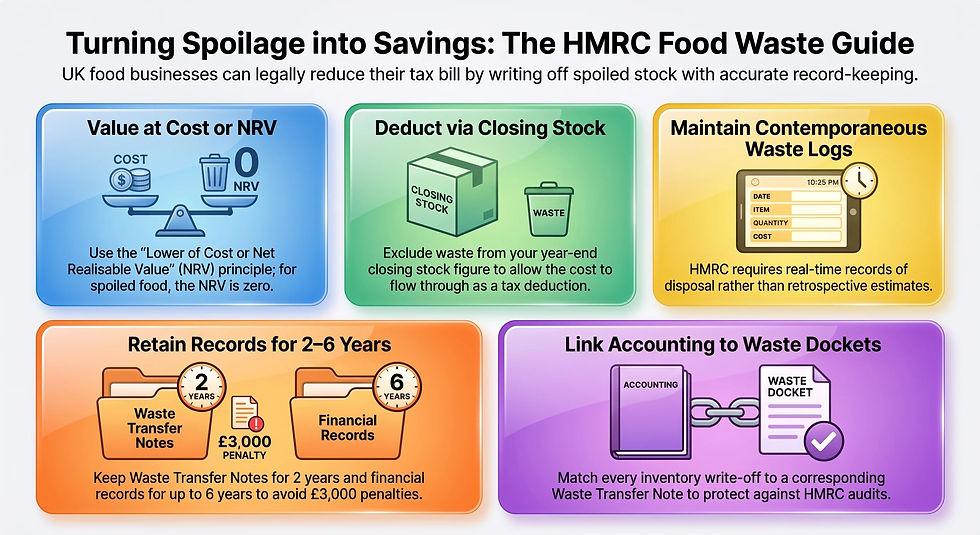
Records That Protect a Food Waste Deduction in a Compliance Check
What HMRC Is Actually Looking For
When HMRC opens an enquiry into a food business's accounts and challenges the level of stock write-offs, the officer's starting point is usually the BIM46555 accuracy test: was the provision arrived at through reasonable commercial judgement, using information available at the time, or does it look like a figure chosen to achieve a tax outcome?
The questions HMRC typically asks include what records were kept of actual disposal, what factors the proprietor took into account in arriving at the provision figure, whether the formula (if used) is consistent year on year or has changed without explanation, and whether the written-off amount is proportionate to the nature of the business and its product mix.
A fish and chip shop or sushi restaurant with high perishability across most of its stock, operating in a trade where daily waste is an entirely expected feature of the business model, is in a different position to a bakery that primarily sells ambient shelf-stable goods and claims 15% annual waste on dry flour and packaging. The credibility of the write-off must match the commercial logic of the specific business.
Digital Records, MTD, and Waste Logs from 2026/27
From 6 April 2026, sole traders with gross income above £50,000 must maintain digital records and submit quarterly updates to HMRC under Making Tax Digital for Income Tax. For a food business already within this threshold, waste records maintained digitally within accounting software are now not just good practice but a practical necessity. Digital waste logs that integrate with the quarterly update process give HMRC a consistent, timestamped audit trail that is far more defensible than paper records assembled at year end.
The quarterly MTD update does not require a precise stock figure each quarter, but a business with material food waste needs to be capturing that waste throughout the year to prepare an accurate year-end stock figure. Leaving all stock reconciliation to January is both a compliance risk and an accuracy risk. The businesses that manage this best tend to reconcile stock on a weekly or at minimum monthly basis and record waste at that point, rather than estimating the full year's loss retrospectively.
From April 2027, the MTD threshold drops to £30,000, bringing a large second group of smaller food businesses within scope. A sole-trader greengrocer, sandwich shop, or market trader with a gross turnover between £30,000 and £50,000 who has previously managed records informally should begin building a digital waste-logging process now, not in spring 2027.
VAT and Food Waste: A Point Frequently Missed
The VAT position on food waste is relevant to VAT-registered food businesses and is occasionally mishandled. Where a business has recovered input VAT on purchases of food that subsequently becomes waste, the position depends on the nature of the supplies for which the food was originally acquired.
For a standard-rated food business, such as a restaurant charging 20% VAT on its sales, input tax on food purchases is recoverable as those purchases relate to taxable supplies. When that food becomes waste, there is no requirement to repay the input VAT simply because the specific food was not sold, provided the food was purchased in the ordinary course of the business and not diverted to an exempt or non-business use.
Where food is donated to a food bank or charity rather than disposed of as waste, the VAT position requires careful thought. Giving away goods for no consideration can constitute a deemed supply for VAT purposes where input tax was recovered on those goods, unless specific reliefs apply. The rules here depend on the circumstances and should be confirmed rather than assumed.
For businesses partly exempt from VAT, such as those with a mix of zero-rated food sales and standard-rated ancillary sales, the input tax attribution rules affect how much of the VAT on food purchases can be recovered in the first place. A write-off does not create a separate VAT problem in most cases, but it can complicate the partial exemption calculation where the waste relates to stock used in the non-taxable part of the business.
Common Errors and HMRC Enquiry Triggers
The patterns that lead to HMRC enquiries in this area fall into a small number of recognisable categories.
A waste figure that is disproportionate to turnover and gross profit without explanation is the most obvious flag. If a food business shows a gross margin significantly below the expected norm for its sector, and the explanation is high stock write-offs, HMRC will typically ask to see the supporting records. An industry benchmark analysis, of the kind HMRC's compliance teams use routinely, will flag a business whose waste claim pushes its gross margin well below the average for comparable businesses.
A provision that stays exactly the same figure year after year is another common trigger. Real food waste fluctuates with trading conditions, seasonal demand, supplier quality, and kitchen management. A flat provision for five consecutive years looks like an estimate made by an accountant rather than a genuine commercial observation by the business owner.
Claiming waste on food categories that do not naturally waste at the rate claimed is a third. A business that primarily sells ambient packaged goods but claims a high fresh produce write-off rate needs that claim to be supported by records showing it genuinely stocks and discards fresh produce at that volume.
None of these patterns automatically mean a claim is wrong. But they each create a risk of a compliance enquiry that a business with proper records will resolve more quickly and at lower cost than one without.

Key Takeaways
Food waste deductions flow through the closing stock figure, not as a separate expense. Spoiled or disposed-of food is valued at nil in closing stock, allowing its cost to fall through as a deduction in cost of goods sold.
HMRC accepts two valuation methods: lower of cost or net realisable value, and mark to market. LIFO is not an acceptable method for stock valuation for tax purposes.
A formula-based provision is acceptable provided it reflects a realistic appraisal of the business's actual waste experience and is documented with an audit trail connecting the formula to observed facts.
From 6 April 2026, sole traders above the £50,000 income threshold must maintain digital records under MTD for Income Tax. Digital waste logs maintained throughout the year provide a far stronger evidential base for a stock loss claim than year-end reconstruction.
A waste provision that is disproportionate to industry norms, flat year after year, or unsupported by underlying records is a compliance risk. Contemporaneous records created at the point of disposal remain the most defensible approach for any food business with material levels of stock loss.
FAQs
Q1: Can a food business claim a tax deduction for stock donated to a food bank rather than physically thrown away?
A1: This is a genuinely nuanced area that trips up a surprising number of food business owners who do the right thing environmentally and then find themselves confused about whether the tax treatment follows. The short answer is yes, food donated to a registered charity or food bank before it reaches its use-by date can still be excluded from closing stock at nil value, provided it was genuinely unsaleable in the normal course of the business. The reasoning is straightforward: the net realisable value of food that cannot realistically be sold is nil regardless of whether it ends up in a bin or a food bank collection point. What matters for the tax computation is that the food is not included in closing stock as if it had recoverable value it does not have. The complication arises when HMRC examines the records and needs to establish whether the donated food was genuinely unsaleable or whether good stock was donated that could have been sold at a reduced price.
A contemporaneous record of each donation, including the date, the product type, the quantity, and the reason it was not sold through normal channels, addresses that question cleanly. One separate point worth being aware of: the VAT position on donated food can differ from the income tax position. If a VAT-registered food business recovers input tax on purchases and then donates the goods rather than using them in a taxable supply, there is a potential requirement to account for output VAT on that deemed supply, unless the value is negligible or specific reliefs apply. Always confirm the VAT treatment of food donations separately from the income tax write-off position.
Q2: What happens to a food business during an HMRC enquiry if no waste records were kept for previous years?
A2: The honest answer is that the outcome depends heavily on how the business responds, and on what other evidence exists to support the claim. HMRC has the power to open a compliance check into any tax return within twelve months of the filing date for a standard enquiry, and up to four years back for careless errors, or six years for more serious cases. When a food business cannot produce waste logs for a year under enquiry, HMRC's compliance officer will typically fall back on what is known as a business economic exercise: using the business's own purchase records, turnover figures, and gross profit margin to assess whether the claimed level of waste is plausible. If the gross margin sits broadly in line with sector norms, the enquiry often concludes without adjustment.
If the claimed waste appears to have depressed the gross margin significantly below expected norms, HMRC will look for corroborating evidence and, in its absence, may propose an amendment to the return. In that situation, the business has the right to appeal and to provide alternative evidence, such as witness statements from staff about disposal practices, supplier delivery records that corroborate purchase volumes, or third-party verification from a waste collection provider. None of these is as clean as a contemporaneous waste log, but they can support the position. The practical takeaway is that starting proper records now, even if prior years are already filed, at least protects future returns and demonstrates to HMRC a genuine intention to comply going forward.
Q3: Does a limited company food business claim food waste write-offs in the same way as a sole trader?
A3: The underlying tax principle is the same: unsaleable food is excluded from closing stock at nil net realisable value, and its cost flows through as a deduction in cost of goods sold. However, the accounting framework differs between the two structures in ways that have practical implications. A limited company preparing accounts under FRS 102 or FRS 102 Section 1A must apply the standard's inventory rules, which mirror the lower of cost and net realisable value principle for all trading stock. The same provisions and formula-based write-downs that HMRC accepts for sole traders are equally valid for limited companies, provided they reflect a realistic appraisal of the recoverable value of the stock. The corporation tax rate for 2026/27 remains 25% for profits above £250,000 and 19% for profits at or below £50,000, with marginal relief available in between.
This means the tax value of a correctly claimed food waste deduction is generally higher for a profitable limited company than for a sole-trader business at the basic rate of income tax. That difference can be material for a catering business or food manufacturer operating through a company structure. One practical distinction is that limited companies must have their accounts approved by the directors and filed at Companies House within nine months of the year end, which means the stock valuation and waste provisions must be finalised and defensible within that timetable rather than being refined closer to the Self Assessment January deadline as some sole traders are tempted to do.
Q4: Can a food business owner claim a write-off for food consumed by employees or used as staff meals?
A4: This is a different category from food waste, and the tax treatment is correspondingly different. Food consumed by employees as a workplace benefit is not a stock write-off in the conventional sense. It is a cost of providing a benefit to staff, and whether it is deductible for the employer depends on whether it falls within the exemptions for workplace meals and canteen facilities or whether it constitutes a taxable benefit in kind. HMRC's guidance on the exemption for free or subsidised canteen meals requires that the meals are available to all employees on similar terms, that the facility is on the employer's premises, and that the meals are not part of a salary sacrifice arrangement. Where those conditions are met, the cost is deductible as a business expense and there is no benefit in kind charge.
Where food is given to selected employees only, or taken home by the owner rather than consumed on the premises, the treatment is more complex. For the sole-trader owner of a food business, food taken for personal consumption is not a business expense at all: it is a drawing. Where the owner eats on the premises during a working day in a way that is genuinely incidental to the trade, a partial claim may be supportable, but this is an area where HMRC scrutinises the wholly and exclusively test carefully. The food waste write-off and the staff meals question need separate documentation, and combining them in a single stock provision figure without distinguishing between them creates an evident difficulty if HMRC ever challenges the accounts.
Q5: How should a home-based food business, such as a cake maker or cottage producer, record and claim food waste?
A5: Home-based food businesses operate in a particularly interesting position for stock loss purposes, because the boundary between personal and business use of food ingredients is both genuinely blurry and very much on HMRC's radar. The wholly and exclusively rule that governs allowable business expenses requires that the cost of ingredients claimed as a business expense was incurred purely for the trade. Flour, eggs, butter, and similar staple ingredients used in both the business and the family kitchen cannot simply be claimed in their entirety as a business cost. Only the portion demonstrably used in the production of goods for sale qualifies. Food waste within the business portion, such as a batch of cakes that failed a quality check and could not be sold or a delivery that arrived damaged, is deductible in the same way as for any other food producer: it is excluded from closing stock at nil value.
The record-keeping challenge is greater for home-based producers because there is no clear physical separation between business and personal stock. The most defensible approach is to maintain a production log that records each batch: the ingredients used, the quantities, the intended sale price, and the outcome, including any batches written off as waste. That log also demonstrates the business's productive activity, which can be relevant in any challenge to the commercial reality of the trade itself. HMRC has historically been alert to hobby business claims in the home baking and cottage food sector, and thorough records serve both the waste claim and the broader question of whether the activity is a genuine trade.
Q6: Can a market trader or street food vendor claim food waste without purchase receipts for the original stock?
A6: The absence of purchase receipts creates a two-stage problem rather than a one-stage one. Before a waste write-off can be considered, the cost of the stock that was wasted must itself be established, which requires some evidence of what was purchased in the first place. A market trader who buys fresh produce from a wholesale market in cash, with no receipts, has a primary record-keeping gap that sits beneath the waste question. HMRC expects business records to include evidence of purchases as well as sales, and a sole trader unable to demonstrate the cost of their stock cannot compute a closing stock figure with any confidence. Where some purchase records exist, such as bank statements showing withdrawals or card payments to a supplier, these can support the broad level of purchases even without itemised receipts.
Waste claims built on top of a partially evidenced purchase record need to be proportionate and conservative. A market trader claiming to have wasted 25% of stock that cannot itself be fully evidenced is presenting a compound record-keeping problem. The more practical approach is to begin maintaining purchase records from the earliest possible date, however informally, and to use that growing evidence base to support waste claims going forward. HMRC's guidance acknowledges that absolute accuracy is not always achievable, particularly for small cash-intensive businesses, but the obligation to exercise reasonable commercial judgement using available information is a minimum expectation in any compliance review.
Q7: Does food waste affect the gross profit percentage that HMRC uses to benchmark a food business, and can a business use industry benchmarks to justify its waste level?
A7: Yes, and understanding this connection is genuinely valuable for any food business owner who has faced or is concerned about an HMRC enquiry. HMRC's compliance teams use gross profit benchmarking as a standard tool: they compare a business's gross margin against expected norms for the sector and use significant deviations as a trigger for deeper examination. High food waste, when correctly recorded and claimed, will naturally depress a food business's gross profit percentage compared to a competitor with lower waste. The problem arises when the waste claim exists in the accounts but is not supported by records that explain the deviation from sector norms.
A legitimate explanation of why a particular business has above-average waste, such as a premium fresh ingredient model with very short shelf life, a rural location with unpredictable footfall, or a catering operation dependent on event bookings that are sometimes cancelled at short notice, is entirely valid if it is documented and consistent with the business's known trading model. What HMRC does not accept is a bare assertion that the business wastes more than the benchmark without any contemporaneous support. Industry benchmarks themselves are a double-edged tool: a business can use them to explain its own position, but HMRC equally uses them to challenge positions that diverge from them. If a business knows its waste is genuinely higher than average for the sector, the records demonstrating why that is the case are more important, not less, precisely because the deviation will be visible in the gross profit calculation.
Disclaimer
The information published on the above article is provided for general informational and educational purposes only. Although reasonable care is taken to ensure that the content is accurate, current and based on reliable sources at the time of publication, UK tax law, HMRC guidance, rates, thresholds and compliance requirements may change, and their application can vary depending on individual or business circumstances. Nothing on this blog constitutes personalised tax, accounting, financial, legal, immigration, investment or professional advice, and it should not be relied upon as a substitute for advice from a qualified professional adviser. Readers should seek tailored advice before making decisions, submitting returns, claiming reliefs, entering transactions, or taking or refraining from any action based on blog content.
Atlas Tax Advisors, its directors, CEO, employees, consultants, contributors, authors, editors and content creators accept no liability for any loss, penalty, interest, damage, claim, cost or consequence arising directly or indirectly from reliance on, interpretation of, or use of any information contained in these blog posts, to the fullest extent permitted by UK law. External references, examples and scenarios are illustrative only and do not create a client relationship. A professional relationship with Atlas Tax Advisors is formed only through formal engagement and agreed terms of service.
Comments