


Furnishing An HMO: Replacement Relief Across High-Turnover Shared Households

Index:
Furnishing an HMO: Replacement Relief Across High-Turnover Shared Households
Replacement of Domestic Items Relief lets a landlord deduct the cost of replacing furniture, furnishings, appliances and kitchenware in a let dwelling-house, but not the initial cost of furnishing it, and this distinction matters more for a House in Multiple Occupation (HMO) than almost any other type of let, because communal items in a shared household wear out far faster than they would in a single-family home. For the 2026/27 tax year, the relief is set out in section 311A of the Income Tax (Trading and Other Income) Act 2005, and HMRC's own manual confirms the mechanics in detail.
I deal with a fair number of HMO landlords, some running a single converted house with four or five lodgers, others with a small portfolio of shared properties, and the pattern I see most often is not landlords missing the relief altogether. It is landlords applying it inconsistently, claiming the full replacement cost of an upgraded item when only part of it qualifies, or getting caught out by the fact that the very first furnishing of a newly converted HMO gets no revenue relief at all.
What the relief actually covers
HMRC's Property Income Manual at PIM3210 sets out four conditions that must all be met for a claim to succeed. The landlord must carry on a property business that includes letting a dwelling-house. An old domestic item that was provided for a tenant's use must be replaced by a new one performing broadly the same function, with the old item no longer available to the tenant. The expenditure must be capital in nature rather than deductible under the ordinary wholly and exclusively rule, and no capital allowances can have been claimed on the new item.
One point worth stating plainly, because it is a genuinely common misconception: the relief does not require the letting to be furnished. That requirement belonged to the old wear and tear allowance, abolished in April 2016, and nothing in section 311A itself conditions the relief on the property being let furnished. A landlord letting an HMO on an unfurnished basis but still supplying, say, a washing machine or kitchen table for shared use can claim on replacing those items exactly as a fully furnished HMO landlord can.
The relief is unavailable for a dwelling-house that is, in whole or part, a furnished holiday letting, though this exclusion has narrowed sharply in relevance since the government's policy paper on abolishing the furnished holiday lettings regime confirmed that treatment ended for Income Tax purposes from 6 April 2025. Former furnished holiday let landlords now fall under the same property business rules as any other residential landlord, which means Replacement of Domestic Items Relief, rather than capital allowances, is now their route to relief on furniture and appliance replacement going forward. It is also unavailable where rent-a-room relief has been claimed on the same dwelling-house.
The distinction that catches HMO landlords out: domestic items versus fixtures
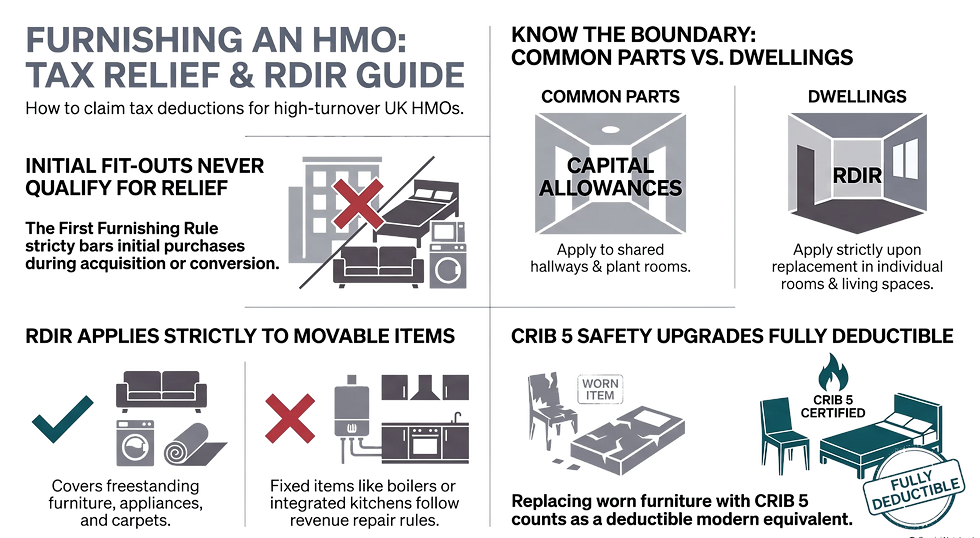
PIM3210 draws a clear line between domestic items, which qualify for this relief, and fixtures, which do not. Domestic items include moveable furniture such as sofas, tables and bed frames, furnishings such as curtains, rugs and carpets, household appliances such as fridges and washing machines, and kitchenware. Fixtures, by contrast, are items that have become part of the building itself: baths, washbasins, toilets, integrated ovens and hobs, and fitted furniture such as built-in wardrobes and cupboards. HMRC's Capital Allowances Manual at CA21000 sets out the underlying test for what counts as plant or machinery fixed to a building, which is the concept this distinction rests on.
This matters disproportionately in HMOs, because converting a house into shared accommodation very often means fitting bedrooms with space-saving, built-in storage rather than freestanding furniture, precisely to maximise usable floor space in what are typically smaller individual rooms. A built-in wardrobe or a fitted desk unit is a fixture, not a domestic item, so replacing it is not a Replacement of Domestic Items Relief claim at all. Instead, the cost may be deductible as a repair to the building under ordinary property income rules, provided it is genuinely a repair rather than an improvement, and provided the work does not amount to replacing a larger "entirety" rather than a discrete part of it, a distinction covered in HMRC's Business Income Manual from BIM46900 onwards. Getting this wrong in either direction, claiming a fitted wardrobe replacement under Replacement of Domestic Items Relief, or treating a genuinely freestanding item as a fixture and claiming it as a repair instead, is one of the more common errors I see corrected on HMO landlords' returns.
Interactive Widget for Replacement Relief for Furnishing an HMO
This interactive explainer from Atlas Tax Advisors guides UK landlords through the specific mechanics of Replacement of Domestic Items Relief (s.311A ITTOIA 2005) across high-turnover Houses in Multiple Occupation (HMOs). It demystifies the critical tax boundaries between qualifying freestanding furnishings and non-deductible fixtures, whilst illustrating how like-for-like replacement caps and disposal adjustments operate under HMRC rules. To use the tool, explore the item classification matrix to check eligibility, and test your own scenarios in the deduction calculator by toggling between like-for-like renewals, upgrades, and initial fit-outs to see your instant allowable revenue deduction and estimated tax savings.
How the calculation actually works
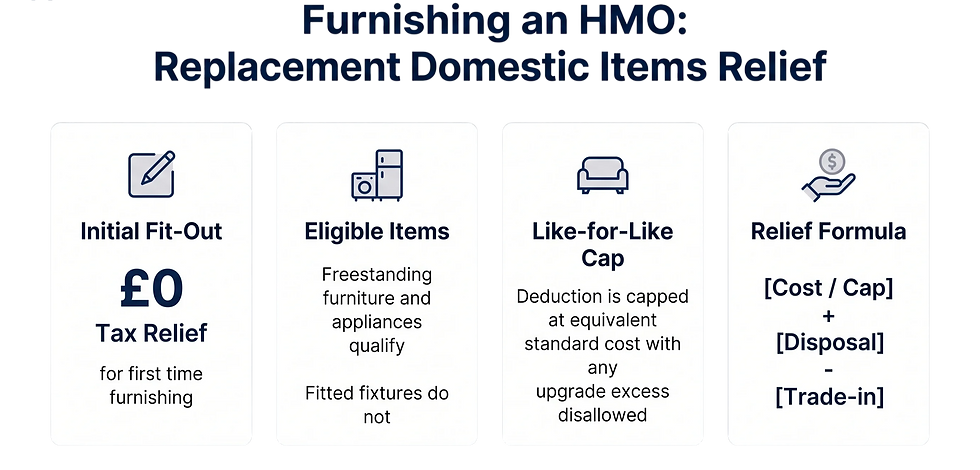
Where the new item is broadly the same quality and standard as the old one, the deduction is simply the cost of the new item, plus any incidental costs of disposal, delivery or installation. HMRC's own guidance makes an important point here: a brand new item is not automatically an improvement over an older one simply because it is new. A budget washing machine bought today to replace a five-year-old budget washing machine of similar original cost is a like-for-like replacement, not an upgrade, even though the new machine is obviously in better condition than the one it replaces.
Where the new item is genuinely of a higher standard, the deduction is capped at the lesser of the actual cost of the new item, and what it would have cost to replace the old item on a like-for-like basis. Any consideration received for the old item, selling it privately, taking a deposit deduction, or trading it in, reduces the claim pound for pound, and a part-exchange is treated the same way, with only the cash top-up beyond the trade-in value being deductible.
A worked HMO example
A shared house with five let rooms has a communal lounge sofa used daily by all five tenants, which is a far heavier pattern of use than the same item would see in a single-family home. The sofa, originally a mid-range three-seater costing £550 four years ago, is now damaged beyond reasonable repair. The landlord replaces it with an equivalent mid-range three-seater costing £620 today, disposing of the old sofa through a local reuse scheme for no payment. Because the replacement is of broadly the same standard, the deduction is £620 in full, reflecting only inflation and normal replacement cost rather than any improvement.
Contrast this with a landlord who takes the opportunity to upgrade the same communal lounge to a much larger corner sofa suite costing £1,400, judging that the extra size will genuinely improve tenant satisfaction and reduce turnover. Here the deduction is capped at what a like-for-like three-seater replacement would have cost, say £650 in current prices, with the remaining £750 treated as capital expenditure on an improvement, not deductible against rental income at all, though it will form part of the property's base cost for Capital Gains Tax purposes on an eventual disposal.
This same logic applies to the sort of upgrade an HMO landlord is often pushed into by licensing conditions rather than choice, replacing ageing furniture with items that meet current fire safety standards for shared housing. Where the new item performs the same function as the old one and is not, in itself, a step up in general quality or specification, meeting a safety standard does not automatically turn a like-for-like replacement into an improvement. Where the enforced upgrade also happens to be materially better furniture than what it replaced, the improvement cap still applies to the excess. This is a judgement call in each case, and it is worth keeping the reasoning behind it recorded at the time, rather than reconstructing an argument for HMRC months or years later.
HMO Replacement Relief and Compliance Summary
HMO Aspect | Tax & Regulatory Rule | Practical Impact for Shared Households |
Initial Furnishing Expenses | Initial purchase costs for domestic items/furniture in a rental property are strictly non-deductible for tax purposes. | Landlords must absorb the full initial setup costs of furnishing an HMO without claiming tax relief until items need replacing. |
Replacement Domestic Items Relief (DIR) | Tax relief is provided against rental income for purchasing a replacement item, calculated as replacement cost minus any improvement element, minus old item sales proceeds, plus disposal costs. | In high-turnover HMOs with frequent wear and tear, direct replacements of items provided solely for tenant use can be offset against rental income. |
Like-for-Like vs. Functional Improvement | Relief only applies to identical or substantially similar replacements (or reasonable modern equivalents). Upgrading functionality (e.g., sofa to sofa bed) or material quality restricts relief to the cost of a non-upgraded equivalent. | Upgrades made during turnover (e.g., replacing a standard sofa with a sofa bed or upgrading carpet materials) result in partial loss of tax deductions for the excess cost. |
Property Acquisition Documentation | Specific itemised values for existing domestic appliances and furnishings should be detailed in the purchase contract. | Establishing clear baseline values for existing items during an HMO purchase simplifies proving eligibility for DIR when items are later replaced. |
The initial fit-out trap when converting a property into an HMO
The most expensive mistake I see in this area has nothing to do with the replacement calculation itself. It is a landlord converting a former single-family home into a licensed HMO, furnishing every bedroom and the communal areas from scratch, and assuming some form of tax relief applies to that initial spend. It does not. Condition B of the relief specifically requires an old item to have existed and been replaced; there is no relief at all for the first time a dwelling-house is furnished.
Before April 2025, a furnished holiday letting could route this kind of expenditure through capital allowances instead, but that option closed when the furnished holiday lettings regime was abolished, and an HMO let on standard residential terms was never eligible for that treatment in any event. The practical result is that the full cost of an initial HMO fit-out, beds, wardrobes, sofas, kitchen appliances, crockery, sits outside revenue relief entirely. It is not lost forever, since it forms part of the base cost of the property (where it relates to fixtures forming part of the building) or simply remains unrelieved expenditure (where it relates to freestanding domestic items that are not part of the building), but it does nothing to reduce the rental profit in the year the HMO opens for business. Landlords budgeting a conversion should plan on this basis rather than assuming the fit-out bill will soften that first year's tax position.
Practical record keeping for high-turnover shared households
An HMO with several tenancies turning over independently through the year generates a volume of small, frequent replacement transactions that a single-family let simply does not: a broken kettle here, a damaged mattress there, a communal dining chair that finally gives way. Individually these are minor, but across a busy year they can add up to a meaningful deduction, and they are also the kind of item most likely to be paid for in cash or through a personal card and then forgotten about by the time the tax return is prepared.
A simple running log, noting the item replaced, the date, the cost, whether the old item generated any sale or trade-in value, and a one-line note on whether the new item was genuinely like-for-like or an upgrade, is far more reliable than trying to reconstruct this from bank statements and memory at year end. This matters particularly where a landlord's HMO income already brings them within Making Tax Digital for Income Tax, since the quarterly update cycle rewards this kind of discipline rather than a single end-of-year scramble through a shoebox of receipts.
Interactive Explainer for Replacement Relief for Furnishing an HMO
This interactive explainer helps UK HMO landlords understand and correctly claim Replacement of Domestic Items Relief under ITTOIA 2005 section 311A and HMRC’s Property Income Manual PIM3210. It covers the four statutory conditions, the crucial distinction between domestic items and fixtures, how like-for-like versus upgrade calculations work, and the common traps that catch high-turnover shared households—especially the lack of relief on an initial fit-out. Simply use the tabs at the top to move between sections, expand the accordions for more detail, and try the built-in calculator to estimate an allowable deduction on any replacement. The guidance is designed for the 2026/27 tax year and applies across the whole of the UK.
Scotland and Wales
Replacement of Domestic Items Relief is a UK-wide Income Tax measure, and the calculation, the four conditions, and the fixtures distinction all apply identically to an HMO in Edinburgh, Cardiff or Milton Keynes. There is no separate Scottish or Welsh version of this relief.
Where the position genuinely differs is in HMO licensing itself, which is a housing and regulatory matter rather than a tax one. England and Wales share a broadly similar mandatory licensing framework under the Housing Act 2004, though administered by each local authority individually, while Scotland runs its own distinct HMO licensing regime under separate Scottish legislation, with different thresholds and conditions from those south of the border. A landlord with HMOs in more than one nation needs to treat the licensing conditions, including any furniture or fire safety standards those conditions impose, as genuinely separate matters from the tax treatment, since the licence requirements will differ even though the tax relief on any resulting furniture replacement does not.
Key takeaways
● Replacement of Domestic Items Relief covers the cost of replacing furniture, furnishings, appliances and kitchenware in a let dwelling-house, and does not require the property to be let furnished.
● There is no relief at all for the initial cost of furnishing a property, including a newly converted HMO, which is a common and expensive point of confusion.
● Fixtures, such as fitted wardrobes, integrated appliances and sanitaryware, do not qualify for this relief; replacing them is a repairs question instead, subject to its own rules on entireties and improvements.
● Where a replacement is genuinely an upgrade rather than like-for-like, the deduction is capped at what an equivalent replacement would have cost, with the balance treated as non-deductible capital expenditure.
● HMO communal items typically wear out faster than in single-family lets, making accurate, contemporaneous record keeping of each replacement more valuable than it might be for a lower-turnover property.
● The relief itself is identical across the whole of the UK; only HMO licensing requirements, which are a separate regulatory matter, differ between England, Wales and Scotland.
FAQs
Does my HMO have to be let furnished to claim Replacement of Domestic Items Relief?
No. The relief applies whenever a domestic item provided for a tenant's use is replaced, regardless of whether the letting is furnished, part-furnished or unfurnished. The furnished-only condition belonged to the old wear and tear allowance, which this relief replaced in 2016.
Can I claim relief on the furniture I bought when I first converted my house into an HMO?
No. The relief only covers replacing an item that already existed and was in use; the initial cost of furnishing a property, including a first-time HMO conversion, is capital expenditure and is not deductible under this relief.
What is the difference between a domestic item and a fixture for this purpose?
A domestic item is moveable, such as a sofa, freestanding wardrobe, or kitchen appliance not built into the structure. A fixture has become part of the building itself, such as a fitted wardrobe, an integrated oven, or a bathroom suite, and does not qualify for this relief, though replacing it may be deductible as a repair instead.
If I upgrade a communal sofa to something much nicer than the one it replaces, can I claim the full cost?
No. Where the new item is materially better than the old one, the deduction is capped at what a like-for-like replacement would have cost, with the excess treated as non-deductible capital expenditure on an improvement.
Does replacing furniture to meet HMO fire safety licensing conditions count as an improvement?
Not automatically. If the new item performs the same function as the old one and is not, in itself, a step up in general quality, meeting a safety standard does not by itself convert a like-for-like replacement into an improvement, though the improvement cap still applies if the new item is genuinely superior overall.
Do I need to deduct anything if I sell the old furniture before buying its replacement?
Yes. Any money you receive for the old item, whether from a private sale or a trade-in against the new purchase, reduces the amount you can claim, pound for pound.
Does the abolition of furnished holiday lettings affect HMO landlords directly?
Not directly, since HMOs let on standard residential terms were never within the furnished holiday lettings regime. It is relevant background because former furnished holiday let landlords now rely on this same relief for furniture and appliance replacement, having lost access to capital allowances from 6 April 2025.
Is HMO licensing the same across England, Wales and Scotland?
No. England and Wales share a broadly similar mandatory licensing framework under the Housing Act 2004, administered locally, while Scotland operates its own separate licensing regime under different legislation. The tax relief covered in this article, however, applies identically across all three nations.
How should I keep records given how often items get replaced in a shared house?
A simple running log noting the date, the item, the cost, any money received for the old item, and whether the replacement was genuinely like-for-like, is far more reliable than reconstructing the position from bank statements at the end of the tax year, particularly given how many small transactions a busy HMO can generate.
Disclaimer
The article content is checked against primary sources, including GOV.UK and HMRC guidance and manuals, and is reviewed at least annually. Worked examples and figures are illustrative and are included to show how the rules apply in principle. They are not a calculation of your own liability.
Tax is highly fact-sensitive. Small differences in circumstances, timing, residence, or structure can change the outcome significantly, and the rules themselves change frequently. This article is therefore general information and is not advice for your situation. You should not act, or refrain from acting, on the basis of this article alone. Atlas Tax Advisors accepts no liability for any loss arising from reliance on it without taking advice. For your specific situation, please contact us or any professional accountant.

Comments