


New Joiner Without P45 , Starter Checklist And Tax Code 2026/27

Updated: Oct 3
Index:
New Joiner Without a P45: Starter Checklist and Tax Code for 2026/27
When a new employee joins without a P45, the employer must use the HMRC Starter Checklist to determine the correct tax code and NIC treatment from day one. The checklist replaced the older P46 and is the only official mechanism for establishing a starter's tax position in the absence of a P45 from a previous employer.
Why the P45 Matters (and What Happens Without One)
A P45 carries three pieces of information that the new employer needs: the employee's leaving date, their total pay to date in the current tax year, and the total tax deducted so far. With that information, the new employer knows exactly where the employee sits against the personal allowance and can apply the correct cumulative tax code.
Without a P45, none of that information is available. The employer must make assumptions about the employee's circumstances, and those assumptions drive the tax code. Getting this wrong typically results in either too much or too little tax being deducted in the early weeks, which then has to be corrected through the payroll or via HMRC's self-assessment or PAYE reconciliation process.
The most common reason employees arrive without a P45 is that they have not yet received it from their previous employer. The previous employer has an obligation to issue a P45 promptly on an employee's last day, but in practice this does not always happen. Newly self-employed individuals returning to employment will also have no P45 to provide. Students starting their first job, and people returning to work after a break, are in the same position.
The Starter Checklist: Three Statements, One Decision
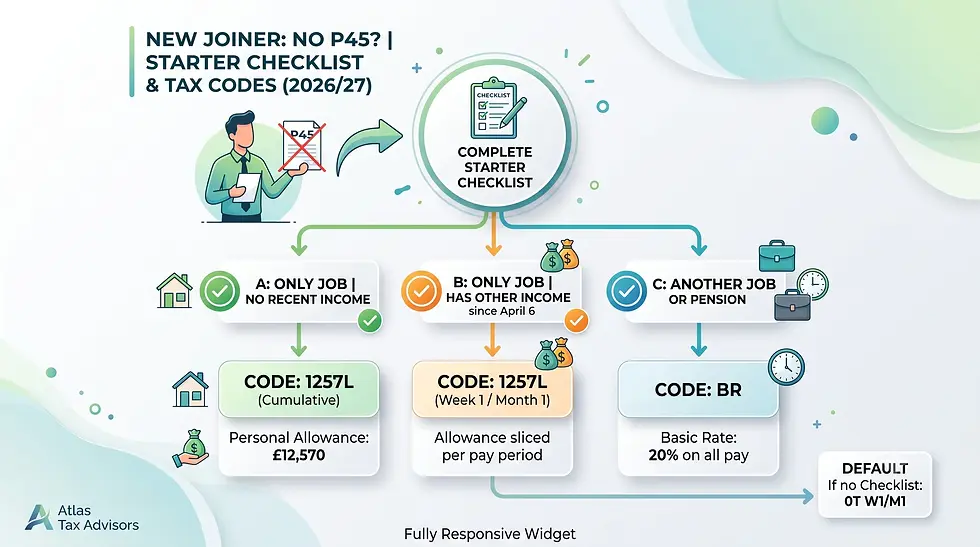
The Starter Checklist asks the employee to confirm which of three statements best describes their situation. Statement A applies if this is the employee's first job since 6 April in the current tax year and they have not been receiving benefits. Statement B applies if this is their only job but they have had another since 6 April or they have received certain state benefits. Statement C applies if they have another job or are receiving a pension alongside this employment.
The statement the employee ticks determines the tax code the employer applies on the first payroll run.
Statement A produces tax code 1257L (the standard code for 2026/27) operated on a cumulative basis. This is the most favourable outcome for the employee. It assumes they have had no other employment income in the current tax year, so the full personal allowance of £12,570 is available against earnings from day one.
Statement B produces tax code 1257L on a Week 1/Month 1 basis. This means the personal allowance is divided into weekly or monthly slices and applied only to the pay in each period, with no reference to what has gone before. This prevents the employee from receiving too large a personal allowance if they had income earlier in the year from a previous employer, but it also means over-deducted tax will not automatically be refunded through payroll in the same way as under a cumulative code. Any correction tends to come at year end through HMRC's reconciliation.
Statement C triggers tax code BR. This withholds tax at the basic rate (20%) on all earnings in this employment, without any personal allowance. This is appropriate where the employee has another job or a pension that is already using up their personal allowance.
Scottish and Welsh Employees
The same three-statement structure applies, but the tax code changes to reflect devolved income tax rates.
For a Scottish employee, the codes become S1257L, S1257L on Week 1/Month 1 basis, or SBR, depending on the statement ticked. Scottish income tax rates for 2026/27 differ from the rest of the UK above the basic rate threshold, so the employer must know the employee is a Scottish taxpayer to apply the correct code. An employee who tells their employer they live in Scotland will have an S-prefix applied.
For a Welsh employee, the C-prefix applies (C1257L or CBR), though in practice Welsh income tax rates are currently set to mirror the UK rates and the financial outcome is the same.
If the employer gets the prefix wrong, the payroll software may apply incorrect tax rates. HMRC will correct this through a coding notice in due course, but it creates an administrative correction to manage.
The 2026/27 Tax Code Figures
The personal allowance for 2026/27 remains at £12,570. This gives rise to the standard tax code 1257L.
The basic rate of income tax is 20%, applying to taxable income between £12,570 and £50,270.
The higher rate is 40%, applying from £50,270 to £125,140.
The additional rate is 45% above £125,140.
Under BR, all earnings in the employment are taxed at 20% with no personal allowance offset.
NIC thresholds for 2026/27 are: employee contributions begin above the primary threshold of £12,570 per year. Above that, the employee rate is 8% up to the upper earnings limit of £50,270, and 2% above that. Employer NIC begins above the secondary threshold, which was reduced to £5,000 per year from April 2025 and remains at that level for 2026/27. Employer NIC rate is 15%.
These NIC figures apply regardless of which Starter Checklist statement was selected. The checklist determines the income tax code, not the NIC treatment.
What the Employer Must Do in Practice
Once the Starter Checklist is completed (ideally before the first pay run), the employer enters the information into their payroll software. The software generates the appropriate tax code and applies it.
The employer does not send the Starter Checklist to HMRC. It is a document for the employer's own records and provides the basis for the initial tax code. What the employer does submit is the Full Payment Submission (FPS) through Real Time Information, which tells HMRC that a new employee has started. The FPS includes the starter declaration (A, B, or C), the employee's personal details, and the pay and deductions for the first pay period.
HMRC uses the information in the FPS to match the new employment against their records. Once the match is made, HMRC will typically issue a coding notice (P9 or P6) to update the tax code if their records show a different code should apply.
In a well-functioning process, this happens within a few weeks. The employer then updates the payroll accordingly. The transition from the starter code to the HMRC-confirmed code can occasionally result in a catch-up adjustment in the period the new code is applied.
Where the employee's circumstances are straightforward and Statement A was correctly ticked, HMRC's records will generally confirm the same 1257L cumulative code and no adjustment is needed.
What If the Checklist Is Not Completed?
This is where mistakes become more costly. If the employee does not complete the Starter Checklist before the first payroll run, the employer must apply a default tax code.
If the employer does not have a P45 and the employee does not complete the Starter Checklist, the employer must use tax code 0T on a Week 1/Month 1 basis. Code 0T withholds tax on all earnings with no personal allowance and applies the appropriate rate bands as if the employee had no allowances at all.
Code 0T is therefore more restrictive than BR (which applies 20% to all earnings), because 0T applies 20%, 40%, and 45% on the relevant income bands without any personal allowance offset. For an employee whose gross pay falls entirely within the basic rate band, BR and 0T produce the same result. For someone paid at a higher rate, 0T will deduct more tax than BR.
The practical lesson is to ensure the Starter Checklist is completed before the first pay run, or at the latest simultaneously with it. Chasing it up after the fact leads to a correction in the next period, which the employee may query.
When the Employee Provides a P45 After Starting
This does happen. An employee joins without a P45 because their previous employer has not yet issued it, and it arrives two or three weeks into the new employment.
If the P45 is received before the first payment is made in this employment, the employer should use the P45 figures and ignore the Starter Checklist entirely. The P45 tax code (as long as it is still a valid cumulative code from the current tax year) is applied from the start.
If the first payment has already been made using the starter code before the P45 arrives, the employer cannot simply switch to the P45 figures mid-stream without an adjustment. The approach is to update the payroll with the new code on a Week 1/Month 1 basis for the next pay period, unless the cumulative calculation produces a more accurate result. HMRC's payroll guidance covers the precise mechanics.
Where the P45 shows a code from the previous tax year, it cannot be used. The employer should treat the employee as if no P45 was provided and use the Starter Checklist code.
Common Errors in the Starter Process
The most frequent practical problem is the employee completing the wrong statement on the Starter Checklist, usually through misunderstanding rather than any intent to evade.
Statement B is often ticked incorrectly. Some employees tick B when they should tick A because they think any previous job in the year means they should tick B. Statement B is intended for employees who have had a job since 6 April but are now starting this as their only job. An employee who left a job six months ago and has had no income since should tick A. Getting this wrong results in the Week 1/Month 1 code instead of cumulative, which will usually mean slightly higher tax deductions in early pay periods.
Statement C is sometimes ticked incorrectly by employees who have a small amount of self-employment income alongside their new employment. Self-employment is not another employment; it does not trigger Statement C in the same way as a concurrent PAYE job. However, the employer and employee should be aware that if self-employment profits are expected, the self-employment income will need to be declared through Self Assessment, and the employee's tax code may be adjusted by HMRC to collect any additional liability.
Another common error is applying a cumulative code to an employee who ticked Statement B. The code for Statement B is 1257L on a Week 1/Month 1 basis, not cumulative. Applying it cumulatively could result in a large refund of early-year tax that has not actually been overpaid on the current employment, because the employee may have used personal allowance against income earlier in the year.

Guidance for Scottish and Welsh Payrolls
For employers who hire across the UK, the obligation to identify Scottish and Welsh taxpayers sits with the employer. The employee's home address is the indicator, not the location of the job. An employee living in Edinburgh who commutes to a Manchester office (unusual but possible) is a Scottish taxpayer.
Most payroll software will prompt for the tax code prefix once the employee's home postcode is entered. Employers running manual payrolls (still common in very small businesses) need to be more careful about applying the right rate table.
Scottish taxpayers on starter codes should be on S1257L, S1257L W1/M1, or SBR. Welsh taxpayers should be on C1257L, C1257L W1/M1, or CBR. If the employer enters a code without the correct prefix, the payroll runs correctly for PAYE income tax at the basic rate but the higher-rate calculations will diverge from what HMRC expects. This tends to surface in the employee's Personal Tax Account and in the end-of-year reconciliation.
Key Takeaways
When an employee joins without a P45, the employer uses the HMRC Starter Checklist to determine the opening tax code. The three statements on the checklist correspond to three different opening codes: 1257L cumulative (Statement A), 1257L Week 1/Month 1 (Statement B), and BR (Statement C).
If the checklist is not completed before the first pay run, the default code is 0T Week 1/Month 1, which withholds tax on all earnings without personal allowance and across all applicable rate bands.
The personal allowance for 2026/27 is £12,570, giving the standard code 1257L. Scottish employees use the S-prefix; Welsh employees use the C-prefix.
HMRC updates the tax code once the RTI Full Payment Submission is received and matched. This typically happens within a few weeks, after which the employer applies any updated code.
If a P45 arrives after the first payment has already been processed using a starter code, the employer follows HMRC's guidance on mid-period code changes rather than simply switching retrospectively.
The Starter Checklist is retained by the employer as a payroll record. It is not sent to HMRC.
FAQs
Q1: What happens if a new employee accidentally ticks Statement A on the starter checklist when Statement B was the correct choice?
A1: This is one of the most common starter checklist errors, and the financial consequence can be surprisingly uncomfortable for the employee. Statement A tells the employer to apply tax code 1257L on a cumulative basis, meaning the payroll software assumes the employee has not worked at all since 6 April and gives them the benefit of every unused month of their personal allowance in one go. If that employee actually received Jobseeker's Allowance or Employment and Support Allowance earlier in the same tax year, or had a job between April and their new start date, that taxable income has already consumed a portion of their personal allowance.
Applying Statement A effectively double-counts the allowance, resulting in an underpayment of tax. HMRC will eventually identify this through their annual reconciliation process, known as a P800 calculation, and will issue a tax bill to the employee after the tax year ends. Consider a warehouse operative who was made redundant in June 2026 and claimed Jobseeker's Allowance for ten weeks before starting a new role in September 2026. If they tick Statement A, the allowance from April to September is given again in full by the new employer, even though part of it was used against their JSA.
The resulting underpayment could easily reach £300 to £500 depending on earnings. The correct statement in that scenario was B. If this error is spotted before the tax year ends, the employee can contact HMRC through their Personal Tax Account, and the employer will receive an updated tax code that corrects the position through the remaining pay runs.
Q2: Can an employer use a P45 from a previous tax year, or does it become invalid once a new tax year begins?
A2: A P45 issued in a previous tax year does carry useful information, specifically the employee's National Insurance number and their tax code at the point of leaving, but it cannot be used in the normal way for payroll purposes in a new tax year. The year-to-date pay and tax figures it contains are no longer relevant once 6 April has passed, because those figures relate to a closed tax year. An employer who attempts to bring those figures into a new-year payroll record will almost certainly apply the wrong tax code or produce incorrect cumulative calculations.
The correct approach when a new joiner produces a P45 dated before 6 April is to note the tax code shown on the P45 and then follow HMRC's guidance for new starters in the current tax year rather than transferring the year-to-date figures. In practice, most payroll software will prompt the employer to treat a prior-year P45 as effectively absent and ask the employee to complete a starter checklist instead. That is the right outcome. The employee should be made aware of this so they do not feel their P45 is being ignored without good reason. Any uncertainty about which tax code to carry forward from the P45 is resolved by the starter checklist answers, which determine the appropriate code for the 2026/27 tax year from scratch.
Q3: What tax code should an employer apply if a new joiner refuses or fails to complete the starter checklist and provides no P45?
A3: If a new employee neither provides a P45 nor completes a starter checklist, the employer has no choice but to apply tax code 0T on a Week 1 or Month 1 basis. This is not an optional response; it is the required treatment under HMRC guidance. Code 0T gives the employee no personal allowance at all, meaning income tax is charged from the very first pound of earnings using the standard rate bands of 20%, 40%, and 45% depending on the level of pay.
For a basic rate taxpayer, the practical effect is identical to the BR code: a flat 20% deduction on all earnings with no tax-free portion. For a higher earner on, say, £5,000 per month, the effect is considerably more severe because the 40% band applies from pound one. The Week 1 or Month 1 basis means each pay period is calculated in isolation rather than cumulatively, which prevents underpayments but also means the employee does not receive any credit for accumulated unused allowance.
The employer should include the new employee on the first Full Payment Submission to HMRC using starter declaration code C, which prompts HMRC to investigate the correct position and issue an appropriate tax code. Any overpaid tax is recovered through the PAYE system once HMRC updates the code, or through a claim at the end of the year if the individual leaves before HMRC can issue a correction.
Q4: If a new employee has two jobs simultaneously, which employer applies the personal allowance and which uses the BR code?
A4: The personal allowance of £12,570 for 2026/27 can only be applied against one source of employment income at a time. HMRC's standard approach is to assign the full personal allowance, through code 1257L, to what is considered the primary employment, which is usually the main or higher-paying job, and to apply code BR to any additional employment. Code BR taxes all income from the secondary job at 20% with no personal allowance applied against it.
The new joiner without a P45 who is starting a second job should tick Statement C on the starter checklist, and the employer will apply code BR from the outset. Where most people run into difficulty is in assuming that BR is always the right code for a second job regardless of income level. If the combined income from both jobs pushes total annual earnings above the basic rate limit (£37,700 above the personal allowance for 2026/27), then some or all of the income from the second job may be taxable at 40%, not 20%.
In that scenario, BR understates the correct liability and the employee will face an underpayment at year end. HMRC should issue a D0 code, which charges 40% on all income from the secondary employment, once they have a complete picture of both earnings. This is why it is worth updating HMRC proactively through the Personal Tax Account when starting a second job, rather than waiting for the annual P800 to flag the shortfall.
Q5: Can an employee claim back overpaid emergency tax during the current tax year rather than waiting until after 5 April?
A5: Yes, and this is genuinely worth doing rather than sitting on the overpayment for months. HMRC's system is designed to correct most overtaxation automatically through the PAYE process once the correct tax code is in place. The fastest route to correction is for the employee to log into their HMRC Personal Tax Account at tax.service.gov.uk, check the tax code currently in operation, and report any relevant information HMRC may be missing, such as the fact that they have no other income or that a previous employer has now ceased. HMRC will then issue an updated tax code to the employer, and the payroll system will recalculate the position cumulatively from the start of the tax year, giving back the overpaid tax through the very next payslip.
The timing depends on when in the pay cycle the new code is received and actioned, but for most employees this results in a noticeably larger pay packet within four to eight weeks. Where the employee has already left the employment on an emergency code before the correction can be made through payroll, they can claim the overpayment back using form P50 if they have stopped working entirely, or by submitting a Self Assessment return or contacting HMRC directly if they have moved to a new employer. The key point is that overpaid tax does not disappear; it is either returned through the PAYE system in-year or reconciled through a P800 or Self Assessment after 5 April.
Disclaimer
The information published on the above article is provided for general informational and educational purposes only. Although reasonable care is taken to ensure that the content is accurate, current and based on reliable sources at the time of publication, UK tax law, HMRC guidance, rates, thresholds and compliance requirements may change, and their application can vary depending on individual or business circumstances. Nothing on this blog constitutes personalised tax, accounting, financial, legal, immigration, investment or professional advice, and it should not be relied upon as a substitute for advice from a qualified professional adviser. Readers should seek tailored advice before making decisions, submitting returns, claiming reliefs, entering transactions, or taking or refraining from any action based on blog content.
Atlas Tax Advisors, its directors, CEO, employees, consultants, contributors, authors, editors and content creators accept no liability for any loss, penalty, interest, damage, claim, cost or consequence arising directly or indirectly from reliance on, interpretation of, or use of any information contained in these blog posts, to the fullest extent permitted by UK law. External references, examples and scenarios are illustrative only and do not create a client relationship. A professional relationship with Atlas Tax Advisors is formed only through formal engagement and agreed terms of service.


Comments