


Should You Pay Off Your Mortgage Or Boost Your Pension

Updated: Oct 3

Index:
Should You Pay Off Your Mortgage or Boost Your Pension?
For most basic and higher-rate taxpayers with a mortgage rate below 6%, increasing pension contributions tends to produce a better financial outcome than overpaying the mortgage, because pension tax relief adds between 25% and 67% to the value of every pound contributed before it has even been invested. The answer changes for higher-rate mortgage deals, for anyone close to drawing their pension, and for self-employed people without stable income. This is a comparison worth running properly rather than assuming, because the right answer depends heavily on your tax position, your mortgage rate, and what you actually plan to do with the money.
I see this question most often from two types of client: a self-employed tradesperson who has just had a strong year and has a few thousand pounds spare, and a contractor or small business owner weighing up a larger lump sum, often after a good contract or a property sale. The maths is different for each, and the answer is rarely as simple as "pensions always win" even though, for most people in most circumstances, they usually do.
The Core Comparison: What Each Pound Actually Buys You
Pension contributions get tax relief before the money is even invested
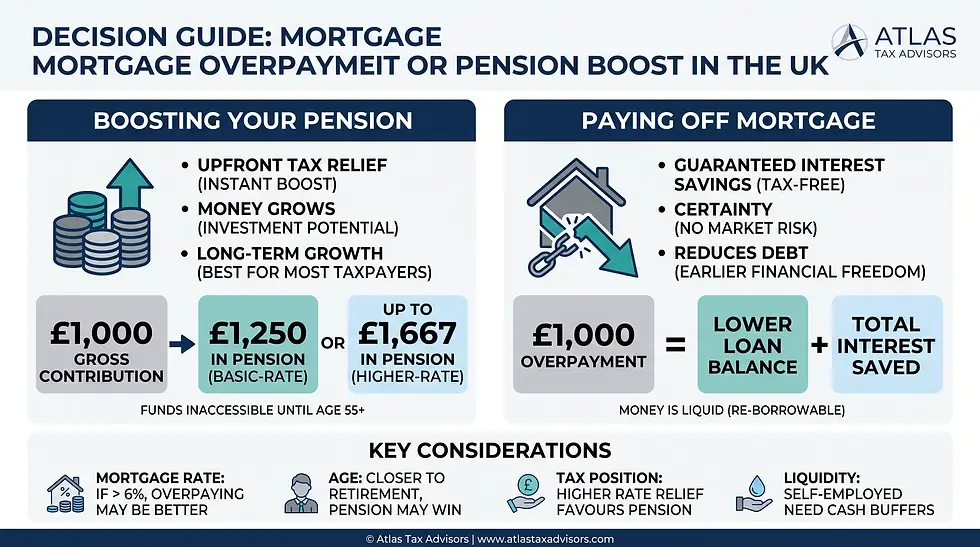
For 2026/27, the pension Annual Allowance remains £60,000, or 100% of your UK relevant earnings if lower. Tax relief is given at your marginal rate of Income Tax. A basic-rate taxpayer paying £80 net into a personal pension or SIPP sees the provider claim £20 from HMRC, turning it into £100 in the pension straight away. A higher-rate taxpayer who contributes £100 gross has effectively paid only £60 of it, once the extra 20% relief is reclaimed through Self Assessment. An additional-rate taxpayer's real cost falls to £55 for every £100 contributed.
This relief is the starting point of the comparison and it is decisive for most people. Overpaying a mortgage with after-tax income does not attract any equivalent uplift. A £1,000 mortgage overpayment is £1,000 of value. A £1,000 gross pension contribution, for a higher-rate taxpayer, has cost only £600 out of their take-home pay.
If you are eligible for salary sacrifice through an employer pension scheme, the comparison improves further. Exchanging salary for an employer pension contribution avoids both Income Tax and National Insurance, including the employee's 8% Class 1 NIC on earnings between the primary threshold and the upper earnings limit, or 2% above it. Many employers also pass on some or all of their own NIC saving as an additional pension contribution. For a higher-rate taxpayer using salary sacrifice, the effective relief on the amount sacrificed can exceed 47%, once both income tax and National Insurance savings are accounted for. This is consistently the most efficient route into a pension for anyone who has access to it, and it is worth checking with your employer whether it is offered, because not every workplace scheme runs on a salary sacrifice basis by default.
Mortgage overpayment saves you the interest rate, guaranteed and tax-free
The benefit of overpaying a mortgage is straightforward: you save the interest rate on the amount overpaid, for as long as that amount would otherwise have been outstanding. If your mortgage rate is 4.5%, every pound you overpay saves you 4.5% a year, guaranteed, with no market risk and no tax to pay on the saving (mortgage interest is paid from after-tax income for almost all owner-occupiers, so there is no comparable relief being given up by overpaying).
As at June 2026, average fixed mortgage rates sit broadly between 4.5% and 5.7% depending on term and loan-to-value, with the best two-year fixed deals available from around 4.35% at lower LTVs. Standard variable rates, which borrowers are moved onto once a fixed deal ends, are running considerably higher, often above 6.5%. This is an important point, because the comparison looks very different depending on whether you are weighing overpayment against a competitive fixed rate or against a lender's default SVR.
What this Widget is About: Created by Atlas Tax Advisors, this interactive decision tool helps UK taxpayers evaluate whether to use surplus cash to overpay their mortgage or boost their pension. By running your personalised figures through up-to-date 2026/27 tax and National Insurance rules, the widget clearly illustrates how upfront tax relief compares against guaranteed, tax-free mortgage interest savings over your chosen time horizon. To get started, simply adjust the interactive sliders to reflect your gross annual income, tax residency (England/Wales or Scotland), available spare capital, and current mortgage interest rate. The visual dashboard immediately models your real net cost, projected investment growth, and lifetime interest saved, highlighting which strategy delivers the stronger financial return for your circumstances. Finally, explore the situational guidance tabs below the results to check essential considerations regarding self-employed liquidity, landlord Section 24 restrictions, and sensible repayment priorities.
Running the Actual Numbers
Take a higher-rate taxpayer with £5,000 spare after their normal spending and saving. They have a mortgage at 4.6% and 18 years remaining, and access to a workplace pension that is not currently maxed out.
Option A: Pension contribution via salary sacrifice. £5,000 of salary given up reduces gross pay by £5,000. Income tax saved at 40% is £2,000. Employee NIC saved at 2% (assuming the £5,000 sits above the upper earnings limit, which is common for someone in the higher-rate band) is £100. Total tax and NIC saving is £2,100, meaning the real cost to the individual is £2,900 for £5,000 landing in the pension, before any investment growth and before any employer NIC saving passed on. Over 18 years, assuming a conservative 5% annual net return, that £5,000 could grow to roughly £12,000.
Option B: Mortgage overpayment. £5,000 off the mortgage balance at 4.6% saves £230 in interest in the first year alone, and considerably more in total interest over the remaining term because the capital reduction compounds. Overpaying £5,000 on an 18-year repayment mortgage at 4.6% saves in the region of £3,500 to £4,000 in total interest over the life of the loan, and can shorten the term by several months, depending on the lender's amortisation schedule.
The pension route wins clearly in this example, both because of the upfront tax relief and because the long investment horizon allows growth to compound on top of that relief. The mortgage route wins on certainty: there is no market risk, and the saving is locked in immediately rather than depending on investment performance.
Comparison: Paying Off Mortgage vs Boosting Pension in the UK
Financial Action | Estimated Pension Pot at Retirement | Estimated Cash Savings/Wealth | Total Financial Wealth (Inferred) | Key Advantages |
Increasing Pension Contributions | £450,000 - £650,000 | £0 - £50,000 | £456,380 - £700,000 | Highest total wealth; significant gains from 20-45% tax relief and employer matching; compound growth over 20 years. |
Balanced Strategy (Split Contribution) | £180,000 - £500,000 | £15,000 - £130,000 | £200,000 - £580,000 | Diversifies assets; combines tax efficiency of pensions with liquidity/flexibility of savings while reducing mortgage debt. |
Investing in an ISA | £100,000 - £376,218 | £60,000 - £210,000 | £160,000 - £530,000 | Tax-free growth and withdrawals; high liquidity provides easy access to capital before age 57; no initial tax relief. |
Overpaying the Mortgage | £100,000 - £427,577 | £0 - £180,000 | £100,000 - £507,871 | Guaranteed risk-free return by avoiding interest; psychological security of being debt-free; reduces future monthly outgoings. |

Where the comparison shifts
The picture changes meaningfully in a few specific situations, and these are the ones worth checking carefully before assuming pensions are automatically the better choice.
Higher mortgage rates. Anyone still sitting on a standard variable rate above 6.5%, perhaps because a fixed deal has lapsed and remortgaging has been delayed, faces a different calculation. A guaranteed 6.5% saving, tax-free, from overpayment starts to compete much more closely with pension relief, particularly for a basic-rate taxpayer whose relief is only 25% (the £20 relief on an £80 net contribution) rather than the higher effective rate available to a 40% or 45% taxpayer. In this situation, clearing the SVR mortgage debt, or at least remortgaging onto a better rate before deciding how to allocate spare cash, usually comes first.
Approaching the pension annual allowance, or already retired. Once you have flexibly accessed a defined contribution pension (taken a taxable lump sum or started drawdown, as distinct from simply taking a tax-free lump sum with no further access), the Money Purchase Annual Allowance applies. The MPAA is fixed at £10,000 for 2026/27 and cannot be increased using carry forward. Someone in this position who wants to keep contributing significantly to a pension may find the annual allowance itself becomes the binding constraint, making mortgage overpayment, or simple after-tax saving, the more practical home for additional surplus income.
Self-employed income volatility. For CIS subcontractors, sole traders, and contractors whose income varies significantly year to year, liquidity matters more than it does for someone on a stable salary. Pension contributions are illiquid until age 55 (rising to 57 from 6 April 2028 for most people, subject to specific protections for certain scheme members). A subcontractor who commits a strong year's profit into a pension and then faces a lean year with a tax bill due on 31 January and 31 July payments on account can find themselves cash poor with no access to the pension funds to bridge the gap. For this group, I generally recommend building a cash buffer of three to six months' essential outgoings before prioritising large pension contributions, and treating mortgage overpayment as a more flexible middle ground, since most lenders allow overpaid capital to be accessed again through further borrowing or a drawdown facility if the mortgage product permits it, which a pension simply does not.
The tapered annual allowance for high earners. If your threshold income exceeds £200,000 and your adjusted income exceeds £260,000 in 2026/27, your annual allowance reduces by £1 for every £2 of adjusted income above £260,000, down to a minimum of £10,000 once adjusted income reaches £360,000. Company directors who have had a strong trading year and are deciding whether to extract profit as a large pension contribution or use it to overpay a buy-to-let or residential mortgage need this calculation done properly before committing, because exceeding the tapered allowance triggers an annual allowance charge that claws back the relief at the marginal rate, on Self Assessment.
What This Means for Landlords Specifically
Landlords weighing up mortgage overpayment against pension contributions face an additional wrinkle: Section 24 of the Finance Act 2015, which restricts mortgage interest relief on residential let properties to a basic-rate tax credit rather than a full deduction against rental profit. This means a higher-rate or additional-rate landlord is, in effect, paying more after-tax interest than the headline mortgage rate suggests, because they cannot deduct the full interest cost before calculating their tax liability.
For a landlord taxed at 40% with a buy-to-let mortgage at 5.5%, the interest cost is only relieved at 20% through the tax credit, meaning the after-tax cost of that interest is considerably higher than it would be for an owner-occupier on the same rate. This tilts the comparison further towards mortgage overpayment on buy-to-let debt, particularly for higher-rate landlords with multiple geared properties, because reducing the mortgage balance reduces an interest cost that is only partially relieved, while pension contributions on rental profits (which do not count as relevant UK earnings for pension purposes, since property income is investment income rather than earned income) cannot in any case be funded directly from rental profit without first being run through a salary or self-employment structure where one exists.
This is worth flagging because it catches people out: rental income on its own does not support a pension contribution. If a landlord's only income is from property, their pension annual allowance available against earnings could be £0, regardless of how much rental profit they make, unless they have other earned income or use their spouse's earnings within a joint structure.
What this Widget is About: This interactive explainer helps UK taxpayers decide whether to overpay their mortgage or increase pension contributions by comparing the real after-tax value of every spare pound under 2026/27 rules. It sets out the core advantages of pension tax relief (including salary sacrifice and National Insurance savings), the guaranteed interest you save by reducing your mortgage, and the key situations—such as high standard variable rates, the Money Purchase Annual Allowance, self-employed income volatility or Section 24 restrictions for landlords—where the balance can tip the other way. Scottish and Welsh tax differences are clearly explained so you can see how devolution affects the figures. Use the tabs to move between the overview, calculator, special cases and a sensible priority order, then enter your own spare cash, tax band, mortgage rate and remaining term into the calculator for a personalised illustration. The results are for guidance only and should be reviewed with regulated advice before you act.
Scotland and Wales: Does Income Tax Devolution Change the Answer?
Pension tax relief operates UK-wide on the same Annual Allowance and the same mechanics, but the rate of relief a Scottish taxpayer receives follows the Scottish income tax bands, which differ from the rest of the UK. For 2026/27, Scotland has six non-savings, non-dividend bands: Starter at 19%, Basic at 20%, Intermediate at 21%, Higher at 42%, Advanced at 45%, and Top at 48%. The Higher rate threshold is frozen at £43,662 for 2026/27, considerably lower than the £50,270 point at which the rest-of-UK higher rate begins, so a Scottish taxpayer earning between £43,662 and £50,270 is already paying 42% while an equivalent English or Welsh taxpayer on the same income is still paying basic rate.
A Scottish higher-rate taxpayer paying 42% on income above that threshold should, in principle, receive pension relief matching that higher marginal rate, but relief-at-source schemes (most SIPPs and personal pensions) apply only the UK basic rate of 20% automatically at source, leaving the Scottish taxpayer to reclaim the extra 22 to 28 percentage points of relief through Self Assessment. This creates a practical timing gap that doesn't arise in the same way for an English or Welsh taxpayer, whose relief-at-source rate matches the UK basic rate exactly and whose only reclaim is the additional 20 or 25 percentage points above that.
Wales uses the same income tax bands and rates as England, since the Welsh Rates of Income Tax have to date been set at the same level as the rest of the UK (20%, 40%, 45%), so no separate calculation is needed for Welsh taxpayers comparing pension relief against mortgage overpayment.
For both Scottish and Welsh residents, the mortgage side of the comparison is unaffected by devolution. Mortgage interest rates and Section 24 restrictions apply identically across all of the UK.

A Sensible Order of Priority
Rather than treating this as a binary choice, most clients are better served by working through priorities in sequence, adjusting the balance as circumstances change year to year.
Clear any high-interest consumer debt first; credit card and personal loan rates almost always exceed both the pension relief case and any realistic mortgage saving. Build an emergency cash buffer appropriate to your income stability, larger for the self-employed than for those on stable PAYE income. Take the full employer pension match if one is offered, since this is an immediate and certain return that neither overpayment nor unmatched pension contributions can replicate. From there, the comparison set out above between mortgage rate and effective pension relief becomes the genuine decision point, and it is worth revisiting annually, since mortgage rates change at the end of fixed deals and personal tax positions change with income.
Key Takeaways
For most basic and higher-rate taxpayers on a competitive mortgage rate, pension contributions, particularly through salary sacrifice, generally produce a better financial outcome than mortgage overpayment, because tax and National Insurance relief is added before any investment growth even begins. That advantage narrows or reverses for anyone on a high standard variable rate, anyone near or past the point of flexibly accessing a pension and subject to the £10,000 MPAA, self-employed people without a cash buffer, and landlords weighing the after-tax cost of restricted mortgage interest relief under Section 24. The right balance depends on your specific mortgage rate, your marginal tax rate, your access to salary sacrifice, and how soon you might need the money, and it is worth recalculating each time any of those change rather than setting a strategy once and leaving it.
FAQs
Q1: Should someone choose pension contributions first if they pay higher-rate tax?
A1: Well, it is often the more tax-efficient move. Pension contributions can receive tax relief, and if the person is in a workplace scheme their employer may also be adding money on top. A mortgage overpayment is made from post-tax income, so the same pound usually works harder inside a pension, especially where there is employer matching. In practice, I would always check the employer contribution first, because that is the part people most often leave on the table.
Q2: Should someone overpay the mortgage if there is an early repayment charge or a limit on overpayments?
A2: In my experience, this is where people can make a costly assumption. If the mortgage deal has an early repayment charge, or if the lender limits how much can be overpaid each year, the apparent savings can shrink very quickly. MoneyHelper says many lenders allow up to 10% overpayment a year without penalties, and flexible or offset mortgages can sometimes let you overpay and draw the money back without charge. So the real test is not “mortgage or pension?” but “what is the mortgage cost after fees?”
Q3: Can someone use tax-free pension cash to reduce a mortgage?
A3: Yes, but it should be done with care. You can usually take up to 25% of a private pension tax-free from age 55, rising to 57 from April 2028, and some people use part of that to clear a chunk of their mortgage. The catch is simple: once that money is gone, it is no longer growing for retirement. I would treat it as a one-off balancing decision, not a routine way to tidy up the mortgage, unless the retirement income forecast still looks comfortable afterwards.
Q4: Does a Scottish taxpayer get different pension tax relief?
A4: The basic relief still works in the same broad way, but the extra relief calculation can differ. Relief at source applies the relevant basic rate for the UK, Scotland or Wales, and Scottish taxpayers who pay tax above the basic level can claim any extra relief through Self Assessment. A common mix-up is assuming Scottish rules reduce the pension benefit at source. They do not; the difference is mainly in how the top-up is claimed.
Q5: Can a self-employed person use pension contributions to improve the balance?
A5: Absolutely, and this is one of the most overlooked angles. HMRC says pension tax relief is available on private contributions up to 100% of annual earnings, and if there are no earnings in a year, relief can still apply on up to £2,880 paid in. For the 2025/26 tax year, the annual allowance is £60,000, so larger year-end top-ups still need a quick allowance check. In practice, I often prefer a modest monthly pension plan for a freelancer, then a top-up once the year’s profit is clearer, because it keeps cashflow steadier.
Q6: Can a limited company director route spare profits into a pension instead of the mortgage?
A6: Yes, and for many directors that is the cleaner tax route. HMRC says employer pension contributions to a registered scheme are generally deductible as a business expense, subject to the usual wholly and exclusively rules. Salary sacrifice can also reduce taxable cash pay where an employer offers it. In plain English, if the company has surplus profit, putting money into a pension can be more efficient than taking the money out first and then paying down the mortgage personally.
Q7: Can someone on PAYE miss out on pension relief without realising it?
A7: Yes, and this is a classic payroll check. If the workplace pension uses net pay, the contribution is taken before tax is worked out, which gives full relief for taxpayers, but not for someone whose pay is too low to create an Income Tax bill. By contrast, relief at source still gives basic-rate relief even where the person does not pay tax. That is why part-time workers, lower earners, and some people with irregular hours should always check how their scheme is set up before assuming the numbers are correct.
Q8: Should someone with bonuses, overtime, or a second job review the decision separately?
A8: Definitely. Variable income can change the answer more than people expect. If bonus pay or a second job pushes total income into a higher tax band, pension contributions may become more valuable because extra relief can be claimed through Self Assessment. I have seen people overpay the mortgage all year, then receive a bonus and realise they have missed an easy higher-rate pension relief opportunity. Once the extra income is known, it is worth re-running the comparison before the tax year ends.
Q9: Should someone clear the mortgage first if they still have expensive debts or a thin cash buffer?
A9: Usually not. MoneyHelper is clear that expensive debts such as credit cards, catalogue balances, and unsecured loans should be tackled before mortgage overpayments, and it also suggests keeping at least three months of money in reserve before paying off the mortgage early. Pension saving is tax-efficient, but it is not a substitute for liquidity. If the boiler breaks or income dips, a solid emergency fund matters more than shaving a little off the mortgage balance.
Q10: What should someone nearing retirement with an interest-only mortgage check first?
A10: This is where the mortgage-versus-pension question becomes a retirement-planning question. With an interest-only mortgage, MoneyHelper recommends checking whether overpayments are allowed, whether any fees apply, and whether the repayment plan is genuinely on track. At the same time, pension money is usually locked away until age 55, rising to 57 from April 2028, so emptying the wrong pot too early can create a bigger problem later. The sensible move is to compare the mortgage deadline, the pension income forecast, and any protected pension age before shifting cash around.
Disclaimer
The information published on the above article is provided for general informational and educational purposes only. Although reasonable care is taken to ensure that the content is accurate, current and based on reliable sources at the time of publication, UK tax law, HMRC guidance, rates, thresholds and compliance requirements may change, and their application can vary depending on individual or business circumstances. Nothing on this blog constitutes personalised tax, accounting, financial, legal, immigration, investment or professional advice, and it should not be relied upon as a substitute for advice from a qualified professional adviser. Readers should seek tailored advice before making decisions, submitting returns, claiming reliefs, entering transactions, or taking or refraining from any action based on blog content.
Atlas Tax Advisors, its directors, CEO, employees, consultants, contributors, authors, editors and content creators accept no liability for any loss, penalty, interest, damage, claim, cost or consequence arising directly or indirectly from reliance on, interpretation of, or use of any information contained in these blog posts, to the fullest extent permitted by UK law. External references, examples and scenarios are illustrative only and do not create a client relationship. A professional relationship with Atlas Tax Advisors is formed only through formal engagement and agreed terms of service.

Comments