


Food Trucks and Market Stalls in Milton Keynes: The Tax Basics of Street Trading

Index:
Food Trucks and Market Stalls in Milton Keynes: The Tax Basics of Street Trading
Almost every food truck operator and market stall trader in the UK is self-employed for tax purposes, whether they trade under their own name or a catchy stall brand, and this means registering with HMRC, paying Income Tax and Class 4 National Insurance on profits, and, for many, deciding how to treat vehicle costs under the newly increased simplified mileage rate for the 2026/27 tax year. Street trading feels informal, cash in a tin, a card reader propped on the counter, but the tax obligations underneath it are exactly the same as any other self-employed business.
I see a fair number of street traders in and around Milton Keynes, from stallholders at the weekend markets in Wolverton and Stony Stratford to food trucks working the events calendar at places like Xscape and the stadium, and the pattern that catches people out most is not usually the headline Income Tax bill. It is the smaller, specific things: which vehicle cost method actually suits a heavily converted van, whether hot and cold food are taxed differently for VAT, and what genuinely counts as a deductible cost when your entire premises is on wheels.
Are you self-employed, and do you need to register?
If you buy stock, prepare food, and sell it to the public for a profit, you are trading, and HMRC treats you as self-employed regardless of whether you have a formal business plan or simply started selling burgers at weekends to see how it went. Some newer traders assume that because a market operator or event organiser pays them through an invoice, or takes a pitch fee off the top, the tax side is somehow being handled for them. It is not. The market or event operator's only obligation is usually to check you have public liability insurance and the right food hygiene registration; your tax position is entirely your own responsibility.
You need to register with HMRC if your gross trading income exceeds £1,000 in a tax year, and the deadline to register is 5 October following the end of the tax year in which you started trading, as confirmed by GOV.UK's guidance on registering for Self Assessment. If you started trading in July 2026, that falls within the 2026/27 tax year, so your registration deadline is 5 October 2027. Registering late does not usually stop you filing correctly, but it can trigger a penalty even where the tax itself is paid on time, so it is worth treating as a fixed date rather than something to get around to once the season winds down.
What you can actually deduct against your takings
The expenses that reduce your taxable profit fall into a few clear categories for a mobile food or stall business, and the errors I see are almost always about scope, claiming something that is genuinely a cost of running the business, but at the wrong proportion, or missing something that is allowable because it does not look like a conventional business expense.
Ingredients and packaging, gas or generator fuel used specifically for cooking equipment, pitch and stall fees, market and event entry charges, food hygiene registration and any required food safety training, public liability insurance, and storage or prep kitchen rental if you use one, are all straightforwardly deductible. Where a cost is genuinely mixed between business and private use, such as a domestic freezer also used to store personal food, only the business proportion is allowable, and you need a sensible, defensible basis for that split rather than an arbitrary round number.
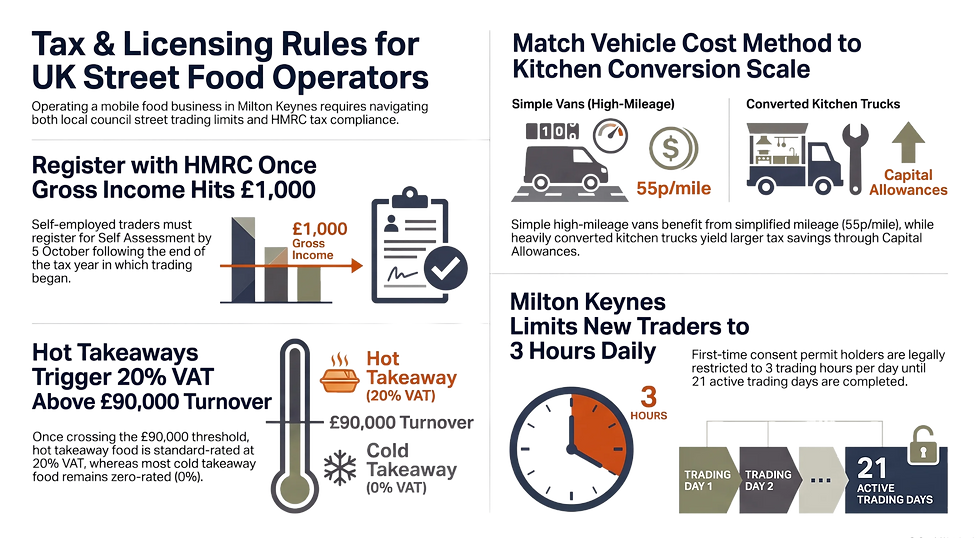
Tax Guide for Food Trucks and Market Stalls in Milton Keynes - An Interactive Graphical Presentation
This interactive guide sets out the essential tax rules for food truck operators and market stall traders in Milton Keynes and across the UK, covering Self Assessment registration, allowable expenses, vehicle cost methods (including the new 55p mileage rate for 2026/27), National Insurance, VAT on hot and cold food, and the practical records you need to keep. Scroll through the clearly labelled sections or expand the accordion for more detail on hot versus cold takeaway VAT treatment. Use it as a quick reference before you register with HMRC, choose how to claim vehicle costs, or check whether you are approaching the VAT threshold. Created by Atlas Tax Advisors, the widget brings the latest official figures together in one place so you can stay compliant without wading through lengthy guidance notes.
Vehicle costs: the decision that actually matters most
For a food truck specifically, the vehicle is usually the single largest cost in the business, and it is also where the two available methods for claiming vehicle expenses produce genuinely different results depending on how the vehicle has been modified.
You can either use simplified mileage rates, a flat rate per business mile that covers all running costs, fuel, insurance, servicing, tyres, and depreciation, in one figure, or you can claim the actual costs of running the vehicle, apportioned between business and private use, alongside capital allowances on its purchase or conversion cost. You cannot mix the two for the same vehicle, and once you have chosen actual costs and capital allowances for a particular vehicle, you cannot switch to simplified mileage for it later.
This matters more for a food truck than almost any other type of vehicle, because a converted catering van is not simply a van. The cost of the conversion itself, a fitted kitchen, extraction, refrigeration, serving hatch, can run into tens of thousands of pounds, and this expenditure sits far outside what a flat mileage rate is designed to cover. A trader running a heavily converted vehicle, driving relatively modest mileage between pitches, is very often better off using actual costs and capital allowances, since the mileage rate does nothing to reflect the size of the conversion investment. A trader running a simpler van, doing higher mileage between multiple markets and events across a season with little in the way of expensive conversion, may still find simplified mileage the more straightforward and sometimes more generous option.
There is a genuinely useful change for 2026/27 worth building into this decision now. HMRC's policy paper on increasing mileage rates confirms that the simplified mileage rate for cars and vans has risen from 45p to 55p per mile for the first 10,000 business miles in a tax year, with effect retrospectively from 6 April 2026, the rate above 10,000 miles remaining at 25p. This is the first change to this rate since 2011, and for a trader who does high mileage moving between markets and events across a season without a heavily converted vehicle, it makes the simplified method noticeably more attractive for 2026/27 than it was for 2025/26.
A worked comparison
A trader running a simple hot dog van, doing 9,000 business miles across the year moving between weekend markets, would claim 9,000 miles at 55p, giving £4,950 under simplified mileage for 2026/27, up from £4,050 at the old 45p rate. A trader running a fully fitted catering trailer that cost £38,000 to convert, doing a more modest 4,000 business miles a year mostly to and from a handful of regular sites, would generally do better claiming capital allowances on the conversion cost over time, alongside actual running costs such as fuel, insurance and servicing apportioned for business use, since 4,000 miles even at the new 55p rate produces only £2,200, nowhere near enough to reflect the scale of the underlying investment in the vehicle itself.
National Insurance on your profits
Class 2 National Insurance stopped being a separate weekly charge from April 2024. For 2026/27, if your profits are at or above the small profits threshold of £7,105, your Class 2 contributions are treated as paid automatically, protecting your State Pension record without any separate payment being due. If your profits fall below that threshold, you can choose to pay voluntary Class 2 contributions at £3.65 a week to keep your record intact, which is worth doing for most traders in a slow first season rather than accepting a gap.
Class 4 National Insurance is charged on your profits once they exceed £12,570, at 6% on profits between £12,570 and £50,270, and 2% above that, figures confirmed in GOV.UK's guidance on self-employed National Insurance rates. This is calculated and paid alongside your Income Tax through Self Assessment, not separately, and both are due by the same 31 January deadline.
UK Street Trading Tax and Regulatory Basics
Tax or Regulatory Area | Applicable Rules & Default Treatment | Key Exclusions & Nuances |
Income Tax Accounting Method | Cash basis is the legal default accounting method for unincorporated sole traders and partnerships (effective 6 April 2024), recording income/expenses strictly when money is received or paid out. Traders must register for Self Assessment with HMRC if gross trading income exceeds £1,000 in a tax year by 5 October following the end of that tax year. | Turnover caps (previously £150,000) have been abolished, allowing businesses of any size to use cash basis. Traders can explicitly opt out to use traditional accruals accounting (e.g., if holding high stock levels). Limited companies and LLPs are excluded. 100% of commercial loan interest expenses are deductible (removing the £500 cap). Capital expenditure on equipment (excluding cars) is deducted directly as an expense rather than via capital allowances. Traders can choose simplified vehicle mileage rates (55p/mile for first 10,000 miles) or actual costs with capital allowances, but cannot switch methods once actual costs are claimed. Market/event organiser fee deductions do not fulfill individual HMRC tax obligations. |
VAT Registration Threshold | Registration for VAT is mandatory if taxable turnover reaches or exceeds £90,000 within any rolling 12-month period (or is expected to within 30 days). | Traders must register within 30 days of crossing the threshold. Businesses earning under £90,000 are not required to register, though voluntary registration allows recovery of input VAT on business purchases. Traders selling primarily cold takeaway food may remain zero-rated, but catering services, hot food sales, and on-premises food consumption count directly towards taxable turnover. |
VAT Rules on Food, Bakery & Drinks | Cold takeaway food, standard cold cakes/pastries, raw ingredients, and basic groceries (bread, eggs, milk, vegetables) are zero-rated (0% VAT). Hot takeaway food (heated to be consumed hot, kept hot, or meeting specific temperature tests), soft drinks, fruit juices, and confectionery carry a standard VAT rate of 20%. | Freshly baked items (e.g., pasties, bread) cooling down naturally are zero-rated unless placed under heat lamps, advertised as 'hot', or sold in heat-retentive packaging. Warming items on-site upon request triggers 20% VAT. Plain chocolate biscuits, plain cakes, and chocolate cakes (e.g., Jaffa Cakes) are zero-rated, whereas chocolate-covered biscuits, potato crisps, and ice cream/frozen lollies face 20% VAT. Providing a customer-operated microwave converts food sales into standard-rated hot food supplies regardless of whether it is used before or after the till point. |
Catering, Premises & Mixed Supplies | All food and drink supplied as a catering service or consumed on 'premises' (including designated seating, shared food courts, or adjacent tables/chairs) is standard-rated at 20% VAT, even for items that are zero-rated as takeaway (e.g., cold sandwiches or milk-based cold drinks). | While purchasing raw ingredients is zero-rated, preparing, presenting, or serving them transforms the supply into a fully taxable 20% catering service. When zero-rated and standard-rated items are sold together for an inclusive price (e.g., 'meal deals' or mixed bundles), VAT must be apportioned based on cost or market value. If a cold ingredient is served inside a single hot item (e.g., cold salad in a hot burger), the entire item becomes standard-rated. Failing to split sales properly can lead to HMRC assessments backdated up to 4 years. |
VAT, and the hot food trap that catches out new caterers
Most new street food traders start well below the VAT registration threshold and do not need to think about VAT at all in year one. You must register once your taxable turnover exceeds £90,000 in a rolling 12-month period, or if you expect to exceed that figure in the next 30 days, as set out in GOV.UK's guidance on VAT registration thresholds. A single very good festival season, several large events booked close together, can push a genuinely small operation over this threshold faster than the owner expects, so it is worth tracking rolling turnover rather than only reviewing it at the end of the tax year.
Once registration does become relevant, catering has a VAT quirk that trips up more food businesses than almost any other rule in this area. HMRC's guidance on catering and takeaway food confirms that hot takeaway food is standard-rated for VAT, while most cold takeaway food remains zero-rated unless it is eaten in a designated seating area provided by the trader. A food truck selling hot burgers, bacon rolls, or a mug of tea to be taken away is making a standard-rated supply, whereas a stall selling cold sandwiches, pastries, or bottled drinks for consumption elsewhere is generally making a zero-rated one. Where a trader sells both, a hot main and a cold dessert or drink from the same till, the two elements need to be treated correctly rather than assumed to follow whichever rate the main item attracts. Getting this split wrong on a VAT return, once registered, is one of the more common and expensive errors in this sector.
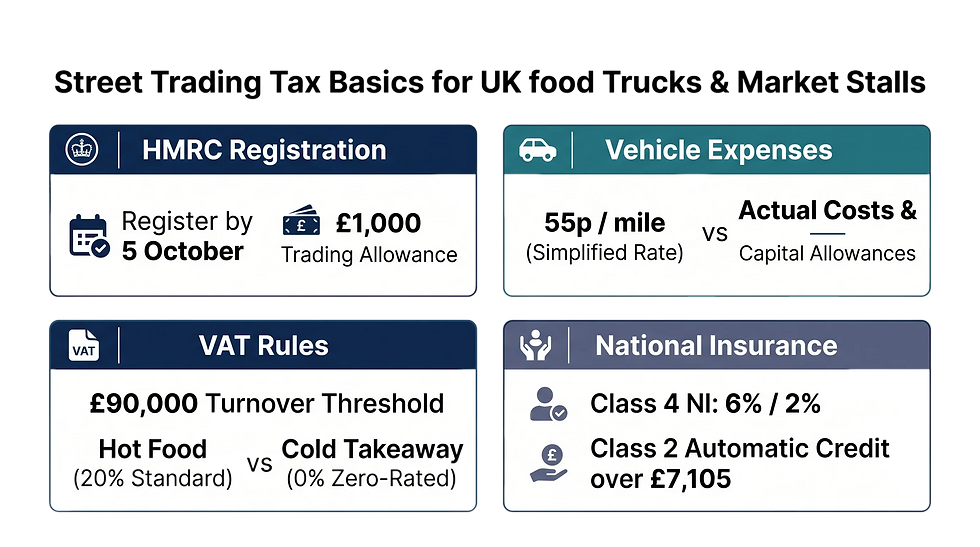
Tax Basics for Food Trucks and Market Stalls - An Interactive Graphical Presentation
Created by Atlas Tax Advisors, this interactive street trading tax toolkit helps mobile caterers, food truck operators, and market stallholders across Milton Keynes navigate their essential HMRC obligations with confidence. It allows you to model your estimated Income Tax and National Insurance liabilities, compare the updated 55p simplified mileage rate against capital allowances on fitted vehicle conversions, and understand critical thresholds such as the £90,000 VAT rule for hot and cold food sales. To get started, simply enter your annual trading figures into the built-in calculators or explore the compliance tabs to assess your tax position and local Milton Keynes licensing requirements in real time.
The other registrations that sit alongside your tax obligations
None of the following are tax matters, but they sit close enough to the tax basics that it is worth flagging them together, since missing one can affect your ability to trade at all, tax position aside.
You generally need to register with your local authority's environmental health team as a food business at least 28 days before you start trading, regardless of whether you are a fixed stall or fully mobile. Depending on where and how you trade, you may also need a street trading consent or licence from the local authority, under powers most commonly derived from the Local Government (Miscellaneous Provisions) Act 1982, and trading at a private event or a managed market usually means agreeing terms directly with the organiser rather than the council, alongside whatever public liability insurance they require as a condition of your pitch.
Record keeping when your premises moves every week
A fixed shop has a till, a bank account tied to a single location, and a fairly natural audit trail. A mobile trader working several different markets and events across a season, often taking a mix of cash and contactless payments through a portable card reader, does not have that structure by default, and needs to build it deliberately.
Reconcile your card reader settlement reports against your bank statements regularly rather than at the end of the year, and keep a simple daily log of cash takings, even a photograph of a handwritten total at the end of each trading day is far better than reconstructing the figure from memory months later. Keep pitch and event booking confirmations, since these double as evidence of where and when you traded, which is useful both for your own profit analysis by venue and, occasionally, for HMRC if your income pattern is ever queried.
Key takeaways
● Street food and market stall traders are self-employed sole traders for tax purposes by default, responsible for their own registration and tax affairs regardless of how a market or event organiser structures payment.
● Register with HMRC by 5 October following the end of the tax year you started trading, once your gross trading income passes £1,000.
● Choose between simplified mileage and actual costs with capital allowances for your vehicle carefully; a heavily converted catering vehicle is often better served by actual costs, while a simpler van doing high mileage benefits more from the 2026/27 increase in the simplified rate to 55p per mile for the first 10,000 miles.
● Class 2 National Insurance is no longer a separate weekly payment for most traders above the £7,105 small profits threshold; Class 4 remains payable at 6% and 2% through Self Assessment.
● Hot takeaway food is standard-rated for VAT while most cold takeaway food is zero-rated, a distinction that matters as soon as you are VAT registered, and one that catches out traders selling a mix of hot and cold items from the same till.
● Food hygiene registration and any street trading consent are separate from your tax obligations but need sorting alongside them before you start trading.
FAQs
Do I need to register as self-employed if I only trade at weekend markets as a side income?
Yes, if your gross trading income exceeds £1,000 in a tax year, you need to register with HMRC by 5 October following the end of that tax year, regardless of whether this is your main income or a side activity alongside employed work.
Can I use the simplified mileage rate for my food truck if I've already claimed capital allowances on the conversion?
No. Once you have claimed capital allowances or actual costs for a specific vehicle, you cannot switch to simplified mileage for that same vehicle, and the two methods cannot be combined.
How much has the mileage rate actually gone up for 2026/27?
The simplified mileage rate for cars and vans rose from 45p to 55p per mile for the first 10,000 business miles in the tax year, backdated to 6 April 2026, with the rate above 10,000 miles remaining unchanged at 25p per mile.
Do I have to charge VAT on my food truck sales?
Only once your taxable turnover exceeds £90,000 in a rolling 12-month period, or you expect it to within the next 30 days. Below that threshold, VAT registration is optional rather than required.
Is hot food really taxed differently from cold food for VAT?
Yes. Hot takeaway food is standard-rated at 20% once you are VAT registered, while most cold takeaway food remains zero-rated, unless it is eaten in a seating area you provide. This matters as soon as registration becomes relevant, since selling a mix of hot and cold items requires splitting the VAT treatment correctly.
What National Insurance do I actually pay as a market trader?
Class 4 National Insurance at 6% on profits between £12,570 and £50,270, and 2% above that, paid through Self Assessment. Class 2 is no longer a separate weekly payment for most traders once profits reach £7,105, though it can be paid voluntarily below that level to protect your State Pension record.
Can I claim the cost of converting a van into a food truck as a business expense?
Generally through capital allowances rather than as a single deduction in the year of purchase, since a conversion of this scale is capital expenditure. This is one of the main reasons actual costs, rather than simplified mileage, often suit a heavily converted vehicle better.
Do I need a licence to trade at markets and events, separate from my tax registration?
Yes, these are entirely separate matters. You will usually need food hygiene registration with your local authority at least 28 days before trading, and depending on where you trade, a street trading consent from the council or agreed terms with the specific market or event organiser.
What records should I keep if most of my takings are cash or card through a portable reader?
A daily log of cash takings, regular reconciliation of your card reader settlement reports against your bank account, and copies of your pitch and event bookings, since these together give you a reliable audit trail that a fixed-premises till would otherwise provide automatically.
Disclaimer
The article content is checked against primary sources, including GOV.UK and HMRC guidance and manuals, and is reviewed at least annually. Worked examples and figures are illustrative and are included to show how the rules apply in principle. They are not a calculation of your own liability.
Tax is highly fact-sensitive. Small differences in circumstances, timing, residence, or structure can change the outcome significantly, and the rules themselves change frequently. This article is therefore general information and is not advice for your situation. You should not act, or refrain from acting, on the basis of this article alone. Atlas Tax Advisors accepts no liability for any loss arising from reliance on it without taking advice. For your specific situation, please contact us or any professional accountant.


Comments