


Beyond Broker Fees: Every Hidden Expense You Can Deduct From Capital Gains

Beyond Broker Fees: Every Hidden Expense You Can Deduct From Capital Gains
Capital Gains Tax (CGT) allows three, and only three, categories of deductible expenditure against a chargeable gain: the acquisition cost itself, enhancement expenditure still reflected in the asset at the time of disposal, and the incidental costs of acquisition and disposal. Section 38 of the Taxation of Chargeable Gains Act 1992, and HMRC's own manual explaining incidental costs, confirm this list is exhaustive, meaning if an expense does not fit within one of these categories, it simply cannot reduce your gain, however genuinely it was incurred in connection with the asset.
Most people I speak with about a share sale or a second property disposal know instinctively that broker commission or estate agent fees reduce the gain. Far fewer realise how much further this list genuinely extends, and equally, how narrowly some of the more obvious-sounding categories are actually drawn. Getting this right on a large disposal can be worth a meaningful sum, and getting it wrong by claiming something that does not qualify creates a real risk if HMRC ever reviews the computation.
The Legal Framework: An Exhaustive List, Not a General Principle
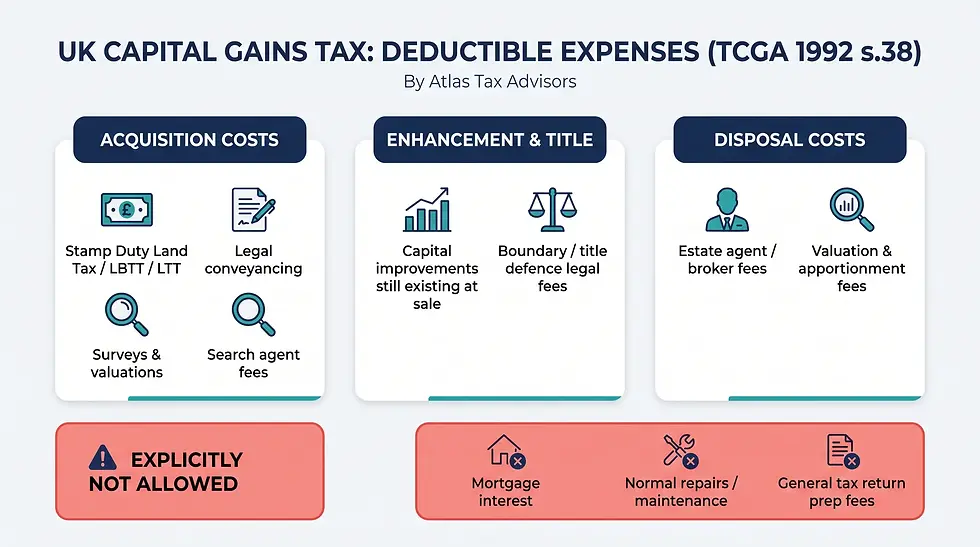
Section 38(1) of the Taxation of Chargeable Gains Act 1992 sets out the full picture. Allowable expenditure comprises the cost of acquiring the asset, expenditure wholly and exclusively incurred on enhancing the asset's value, provided that enhancement is still reflected in the asset's state at the time of disposal, the costs of establishing, preserving, or defending title to the asset, and the incidental costs of both acquisition and disposal, defined precisely in section 38(2). HMRC's guidance is explicit that this definition is exhaustive, and no other expenditure is allowable unless a separate, specific provision elsewhere in the legislation says otherwise. This matters because it means the test is never "was this cost genuinely connected to the asset in some sensible commercial sense," but specifically "does this cost fall within one of these defined categories."
Acquisition Costs Beyond the Purchase Price
The price you paid is only the starting point. Legal fees on the purchase, survey and valuation fees obtained at the time of acquisition, and Stamp Duty Land Tax, or the devolved equivalents, Land and Buildings Transaction Tax in Scotland and Land Transaction Tax in Wales, all form part of the acquisition cost, added to the price itself before any gain is calculated. Less commonly claimed, but equally allowable under section 38(2), are the costs of advertising to find a seller, relevant where you have engaged a search agent or sourcing service to locate a specific type of asset, a particular property, a specific class of shares, or a business, before you have actually identified and agreed to buy it.
What this Widget is About: Created by Atlas Tax Advisors, this interactive visual guide unpacks the exhaustive rules of Section 38 of the Taxation of Chargeable Gains Act 1992, showing you precisely which overlooked expenses—beyond standard broker and estate agent fees—can legally reduce your UK Capital Gains Tax liability. Use the tabbed navigator to explore the statutory boundaries across property and share disposals, search the comprehensive deduction directory to verify whether your specific costs qualify, and test your own figures in the built-in tax shield calculator to see your potential tax savings. Simply select your asset type and toggle allowable deductions to ensure your computation remains fully compliant with HMRC standards while maximising your tax relief.
Enhancement Expenditure: What Still Counts at Disposal
Capital improvements made during ownership, an extension, a loft conversion, a significant renovation, are deductible, but only to the extent they genuinely enhance the asset's value and remain reflected in its state at the point of disposal. This second condition catches people out more often than the first. If you built a garden studio and then demolished it before selling the property, the cost of the studio itself is not deductible, since it no longer forms part of the asset's state at disposal, though the demolition cost might separately qualify if it enhances the remaining asset's value in its own right. Improvement expenditure needs to be kept as a distinct, dated record throughout ownership, since reconstructing which specific works still physically exist in the property years later, at the point of sale, is often far harder than keeping the record contemporaneously.
Establishing, Preserving, or Defending Title
This is a genuinely underused category, and it covers legal costs incurred in establishing your ownership, resolving a boundary dispute with a neighbour, or defending your title against a competing claim. Where a landlord has spent money on solicitors resolving a disputed party wall matter, or establishing clear title to a strip of land before selling a property, those legal costs fall within this category, provided the primary purpose was genuinely establishing or defending ownership rather than, say, general property management. This is distinct from, and sits alongside, the acquisition and disposal costs described elsewhere in section 38, and it is worth reviewing specifically wherever a disposal followed a period of genuine legal uncertainty over ownership.
The Accountant's Fee Trap: What's Actually Allowable
This is where I most often correct a genuine misunderstanding, in both directions. HMRC's own guidance is precise on this point: accountant's fees are allowable only to the extent that they relate to ascertaining the market value of the asset or to any apportionment required for the purposes of the Capital Gains Tax computation itself. General accountancy fees for preparing your tax return, advice on the general state of markets, the prospects of particular investments, or ongoing portfolio management are all specifically excluded, along with subscriptions to investment publications, analyst reports, or stockbroker circulars, regardless of how directly you might feel they informed your decision to buy or sell.
A Worked Example
Take a landlord selling a property that requires a formal market valuation to establish the base cost for a part disposal, since only a portion of the original site is being sold, with the remainder retained. The accountant's fee for obtaining and working through that valuation, and for calculating the correct apportionment of the original acquisition cost between the part disposed of and the part retained, falls squarely within the allowable category, since it is costs reasonably incurred in making a valuation or apportionment required for the computation of the gain. If the same accountant separately charges for completing the client's annual Self Assessment return, including reporting the resulting gain on the CGT pages, that second fee is not deductible against the gain at all, since it relates to general tax compliance rather than the specific valuation or apportionment work the gain calculation required. A single invoice covering both pieces of work should be split accordingly, with only the valuation-related element claimed.
Disposal Costs Beyond the Estate Agent
On the sale side, incidental costs mirror the acquisition side closely: legal fees on the sale, estate agent commission, advertising costs to find a buyer, and costs reasonably incurred in making any valuation or apportionment required for the computation itself. This last category deserves specific attention on part disposals, where an asset is split and only a portion sold, since HMRC's guidance under section 38 of the Taxation of Chargeable Gains Act 1992 explicitly recognises the costs of apportioning the original acquisition cost between the part sold and the part retained as an allowable disposal cost, distinct from and additional to the ordinary legal and agent fees on the transaction itself.
Inherited and Gifted Assets: The Probate Valuation Cost
Where an asset was inherited rather than purchased, its acquisition cost for CGT purposes is the probate value, the market value at the date of death used for the Inheritance Tax account, rather than what the deceased originally paid for it. The cost of formally obtaining that valuation, a professional valuer's fee to establish the property's or shares' value at the date of death, can itself qualify as an incidental cost of acquisition, since it is a cost reasonably incurred in ascertaining market value where required for the purposes of the computation, exactly the language section 38(2) uses. Executors and beneficiaries selling an inherited property or shareholding should keep the original probate valuation invoice specifically, separate from the wider costs of administering the estate, since it may be needed again years later when the asset is finally sold and the gain calculated against that historic base cost.
What's Explicitly Not Allowable
Understanding the boundary of section 38 also means being clear about what falls outside it entirely, since claiming a disallowed cost creates real exposure if HMRC reviews the computation. Interest on any borrowing connected with the asset is specifically excluded under section 38(3) for individuals, regardless of how directly the loan financed the purchase or an improvement. Revenue expenditure, ordinary repairs, insurance, running costs, letting agent management fees for day-to-day tenancy administration, is never allowable against a capital gain, since these costs either belong against rental income for a let property or simply have no home in the tax system at all if the asset was never income-generating. General investment advice, portfolio management fees, and subscriptions to market publications are excluded even where the professional providing them happens to be an accountant or a stockbroker, because the fee relates to the general management or prospects of the investment rather than the specific acquisition or disposal transaction itself.
What this Widget is About: This interactive guide explains every category of expenditure you can lawfully deduct when calculating Capital Gains Tax in the UK, going well beyond the familiar broker or estate-agent fees. Drawing on Section 38 of the Taxation of Chargeable Gains Act 1992 and HMRC guidance, it sets out the exhaustive rules for acquisition costs, enhancement expenditure, title-related legal fees, valuation and apportionment costs, and what is firmly excluded. Simply use the tabs at the top to explore each topic in turn, expand the practical examples and checklists, and test your understanding with the quick knowledge check at the end. The widget has been created by Atlas Tax Advisors to help UK taxpayers identify every allowable deduction and avoid common pitfalls that could attract HMRC scrutiny.
Scotland and Wales: The Same List, Different Property Transfer Tax Names
Capital Gains Tax and the section 38 framework governing allowable costs apply identically across the whole of the UK, since CGT is reserved to the UK government. The only point of genuine terminology difference concerns property transfer tax on acquisition: a property bought in Scotland incurs Land and Buildings Transaction Tax rather than Stamp Duty Land Tax, and a property bought in Wales incurs Land Transaction Tax, but both are treated identically to SDLT as an allowable acquisition cost under section 38(2), simply under a different devolved name. There is no separate Scottish or Welsh version of the underlying CGT expenditure rules, and a valuer's or solicitor's fee is treated exactly the same way regardless of which UK nation the asset sits in.

Practical Steps Worth Taking
● Keep every acquisition and disposal invoice, legal fees, survey and valuation costs, and transfer tax receipts, in a dedicated file for each asset rather than mixed in with general household or business paperwork.
● Record enhancement expenditure contemporaneously, with dates and a description of the work, since establishing years later that an improvement still exists in the asset at disposal is considerably harder without a running record.
● Ask any professional adviser to itemise invoices clearly between valuation or apportionment work, which is allowable, and general tax return preparation or investment advice, which is not, rather than accepting a single combined fee.
● Retain the original probate valuation invoice separately for any inherited asset, since it establishes both your base cost and a potentially allowable incidental cost when the asset is eventually sold.
● Where legal costs relate to defending or establishing title, keep clear records distinguishing this work from ordinary property management or letting-related legal costs, since only the former falls within section 38.
Key Takeaways
The genuinely underused categories in this list, the valuation-specific portion of an accountant's fee, the costs of establishing or defending title, and the incidental costs of apportionment on a part disposal, are worth actively checking for on any significant disposal, not assumed away because they feel less obvious than an estate agent's commission. Equally, understanding what section 38 firmly excludes, interest, general investment advice, and ordinary revenue costs, protects against an inflated claim that HMRC could challenge and unwind, with interest, well after the disposal has already completed.
FAQs
What are the three categories of allowable expenditure for Capital Gains Tax?
The cost of acquiring the asset, enhancement expenditure still reflected in the asset's state at the time of disposal, and the incidental costs of both acquisition and disposal, as defined by section 38 of the Taxation of Chargeable Gains Act 1992. This list is exhaustive.
Can I deduct my accountant's fees from a capital gain?
Only to the extent those fees relate specifically to ascertaining the market value of the asset or to an apportionment required for the CGT computation. General accountancy fees for preparing your tax return, or advice on markets and investment prospects, are not deductible.
Are legal fees for a boundary dispute deductible against a capital gain?
Potentially, yes, where they were genuinely incurred establishing, preserving, or defending your title to the asset, a distinct allowable category under section 38(1) separate from ordinary acquisition and disposal costs.
Is Stamp Duty Land Tax an allowable cost for CGT purposes?
Yes, along with its devolved equivalents, Land and Buildings Transaction Tax in Scotland and Land Transaction Tax in Wales, all of which form part of the acquisition cost of a property.
Can I deduct interest on a mortgage or loan used to buy the asset?
No. Interest is specifically excluded from allowable CGT expenditure under section 38(3) for individuals, regardless of how directly the borrowing financed the acquisition or an improvement.
What happens if I improve an asset but remove the improvement before selling it?
The cost of that improvement is not deductible, since enhancement expenditure only qualifies if it is still reflected in the asset's state at the time of disposal. Any separate cost of removing or demolishing it might qualify in its own right if it enhances the remaining asset.
Can I claim the cost of getting a probate valuation on an inherited property?
Yes, potentially. The probate value becomes your acquisition cost, and the cost of formally obtaining that valuation can itself qualify as an incidental cost of acquisition, since it was reasonably incurred in ascertaining market value for the computation.
Are letting agent management fees deductible from a gain when I sell a rental property?
No. Ongoing management fees are revenue expenditure, deductible against rental income during the letting period, not against the capital gain when the property is eventually sold.
Do the same rules apply if my property is in Scotland or Wales?
Yes. Section 38 and the categories of allowable expenditure apply identically across the whole of the UK. The only difference is that property transfer tax is called Land and Buildings Transaction Tax in Scotland and Land Transaction Tax in Wales rather than Stamp Duty Land Tax, though it is treated the same way as an allowable acquisition cost.
Can I deduct the cost of a part disposal valuation from my gain?
Yes. Costs reasonably incurred in making a valuation or apportionment required for the computation of the gain, common on a part disposal where only a portion of an asset is sold, are specifically recognised as an allowable incidental cost under section 38(2).
Disclaimer
The article content is checked against primary sources, including GOV.UK and HMRC guidance and manuals, and is reviewed at least annually. Worked examples and figures are illustrative and are included to show how the rules apply in principle. They are not a calculation of your own liability.
Tax is highly fact-sensitive. Small differences in circumstances, timing, residence, or structure can change the outcome significantly, and the rules themselves change frequently. This article is therefore general information and is not advice for your situation. You should not act, or refrain from acting, on the basis of this article alone. Atlas Tax Advisors accepts no liability for any loss arising from reliance on it without taking advice. For your specific situation, please contact us or any professional accountant.
Comments