


How Digital Record Keeping Affects Capital Gains Tax Reporting For UK Sole Traders

How Digital Record Keeping Affects Capital Gains Tax Reporting for UK Sole Traders
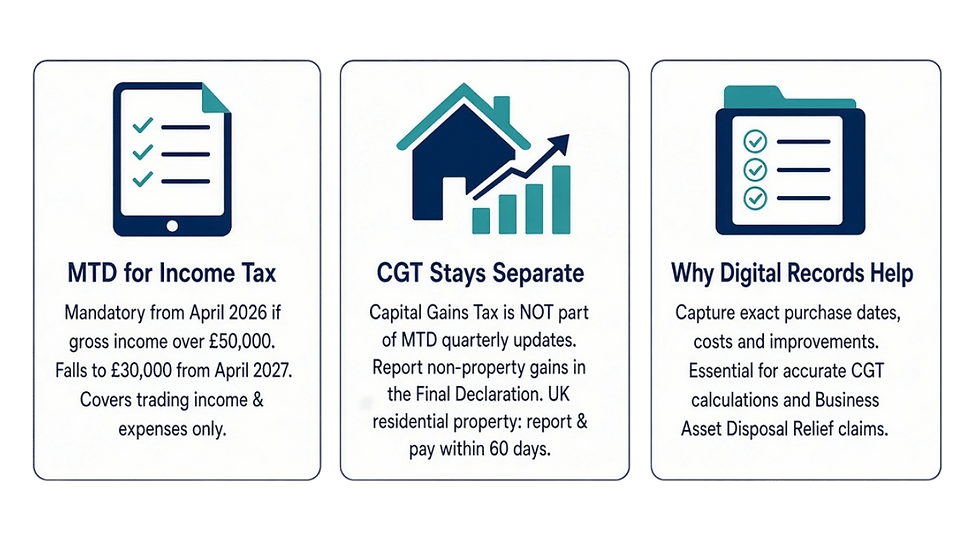
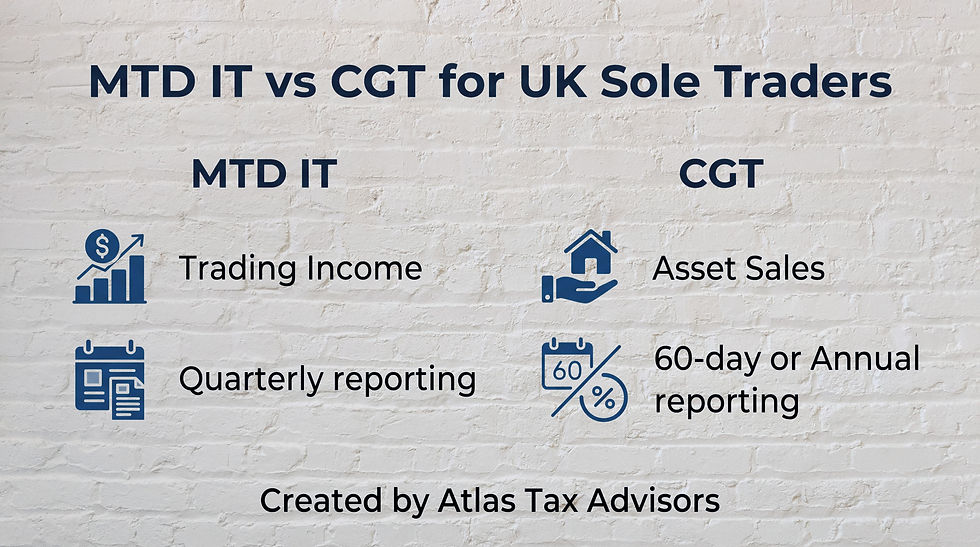
For the 2026/27 tax year, Making Tax Digital for Income Tax (MTD IT) is mandatory for sole traders with gross income above £50,000. From April 2027, that threshold drops to £30,000. MTD IT requires digital record keeping for trading income and expenses, submitted quarterly to HMRC. What it does not cover, and what many sole traders misunderstand, is that Capital Gains Tax reporting operates under entirely separate rules that MTD IT does not change.
CGT arising from a sole trader's asset disposals, whether that is a business asset, a property, or shares, is still reported through Self Assessment and the UK Property Reporting Service where applicable. MTD IT transforms the process for trading income records, but the CGT reporting obligation flows through its own channel and on its own timeline. Getting this distinction wrong creates both reporting errors and missed planning opportunities.
What MTD IT Does and Does Not Require From Sole Traders
The MTD IT Obligations in 2026/27
Under MTD IT, a sole trader with gross trading income above £50,000 in the 2026/27 tax year must maintain digital records of their business income and expenses throughout the year, submit quarterly updates to HMRC by the due dates in each quarter, and file an end-of-period statement after the quarter ending 5 April 2027. The quarterly updates are not full tax returns; they are submissions of cumulative income and expense totals for the trading business.
The digital record-keeping requirement applies to the trading income and expenses. It does not extend to capital transactions. A sole trader plumber in Milton Keynes who sells a commercial property he uses partly for his business, or who disposes of a van at a gain, must report those CGT events separately. The quarterly MTD IT submissions say nothing about them.
HMRC's MTD for Income Tax guidance confirms that digital records must include all income received and all expenses incurred in the accounting period, categorised appropriately, and held in MTD-compatible software that links directly to the HMRC submission. Paper records alone are not sufficient from April 2026 for sole traders in scope.
The Final Declaration Replaces the Full Self Assessment Return
At the end of the MTD IT reporting cycle, the final declaration replaces the traditional Self Assessment tax return for trading income. However, CGT still needs to be declared at this final stage, alongside any other non-trading income such as rental income, dividends, and employment income. The final declaration is the MTD equivalent of the Self Assessment return, not an alternative to it. For a sole trader who also made a chargeable gain during the year, the CGT figures are entered in the final declaration in addition to the quarterly trading data.
This is the point where sole traders most often find themselves caught out. They complete their quarterly submissions diligently and then assume that their tax obligations are met. The CGT from a property or asset disposal still needs to be reported and, in the case of residential property disposals, reported and paid within 60 days of completion under a separate mechanism.
This interactive guide clarifies the crucial differences between the upcoming Making Tax Digital for Income Tax (MTD IT) rules and your ongoing Capital Gains Tax (CGT) obligations as a UK sole trader. While MTD IT digitises your trading income reporting, it does not cover asset disposals, meaning you must still manage CGT through separate channels and timelines to avoid costly penalties. Simply click through the sections below to explore how digital record-keeping impacts your base cost calculations, the 60-day residential property rules, and your eligibility for Business Asset Disposal Relief. Developed by Atlas Tax Advisors, this tool ensures you are fully prepared to navigate both sets of reporting requirements seamlessly.
Capital Gains Tax Reporting: Entirely Separate From MTD IT
The Annual CGT Return Through Self Assessment (Now the Final Declaration)
For gains on assets other than UK residential property, CGT is declared through Self Assessment, which for MTD IT users means including it in the final declaration at the end of the tax year. The annual exempt amount for 2026/27 is £3,000. After deducting the exempt amount and any allowable losses, the chargeable gain is added to other income and taxed at 18% within the unused basic rate band or 24% above it for non-residential assets. These rates and thresholds are confirmed in HMRC's Capital Gains Tax rates and allowances guidance on GOV.UK.
Business assets sold as part of a sole trader's business may qualify for Business Asset Disposal Relief (BADR). BADR reduces CGT to 18% on qualifying gains up to the £1 million lifetime limit (reduced from £1 million as confirmed in 2026/27, though for this article the figure remains £1 million as per HMRC guidance unless further changes were announced). The relief requires the individual to have owned the asset for at least two years and to have used it in their trading business throughout that period.
The 60-Day Reporting Rule for Residential Property
Where a sole trader disposes of a UK residential property that does not benefit from full Private Residence Relief (PRR), CGT must be reported and paid within 60 days of legal completion using HMRC's UK Property Reporting Service. This rule applies regardless of whether the sole trader is within MTD IT or not. MTD IT does not alter or interact with the 60-day residential property reporting requirement in any way.
The 60-day clock starts from the date of legal completion, not exchange. A property completing on 15 August 2026 requires a report and payment by 13 October 2026. Where MTD IT quarterly reports are being submitted for the same period, the CGT property report runs entirely in parallel, in a different system, to a different deadline.
The UK Property Reporting Service on GOV.UK is the specific portal for reporting property disposals. It is separate from the MTD IT portal. A sole trader who disposes of both a buy-to-let property and a business asset in the same tax year may have: a 60-day property report for the rental property, the business asset gain declared in the annual final declaration, and ongoing quarterly MTD IT submissions for trading income. All three are running concurrently and independently.

How Digital Records Actually Improve CGT Accuracy
The practical benefit of digital record keeping for CGT purposes comes not from the MTD IT submission itself, but from what good digital records enable.
A sole trader who has maintained digital records throughout the period of ownership of a business asset can produce a precise capital gains calculation because the original acquisition cost, any improvement expenditure, and the date of purchase are all recorded contemporaneously and retrievable from the accounting software. A sole trader who relied on paper records and memory, or who has reconstructed records at the time of sale, faces a much higher risk of either underclaiming allowable costs or being challenged by HMRC if the figures do not match other data.
The initial cost of an asset, plus any subsequent capital improvement expenditure, forms the base cost for CGT. Deducting a larger base cost reduces the chargeable gain. Common capital improvement costs that sole traders with paper records often miss include: professional fees paid on the purchase of a business property (legal fees, surveyor fees); costs of capital improvements made during ownership (structural works, additional facilities); and, for assets used partly for business and partly personally, the correct apportionment of improvement costs to the business portion.
Where an asset was purchased several years ago and has been subject to multiple improvement works, good digital records provide the evidence trail to claim these costs. Without that evidence, HMRC can challenge the base cost calculation during a compliance check, and the dispute about cost amounts can be very difficult to resolve without contemporaneous documentation.
MTD-Compatible Software and CGT Records
MTD-compatible accounting software keeps digital records of trading income and expenses, but it typically also has asset registers and depreciation schedules. A sole trader who records business asset purchases in their MTD-compatible software at the time of purchase has, almost as a by-product, created the CGT base cost record for that asset. The purchase price, date, and any subsequent improvement costs are captured in the asset register.
When the asset is eventually sold, the same software can produce the gain calculation from the records it already holds. This is not a function of MTD IT itself but of good digital accounting practice that MTD IT encourages. Software such as Xero, QuickBooks, and FreeAgent all maintain asset registers, and for sole traders whose businesses hold significant fixed assets, using that functionality correctly is directly relevant to their CGT position when they eventually sell.
This interactive guide explains how Making Tax Digital for Income Tax (MTD IT) affects Capital Gains Tax reporting for UK sole traders from the 2026/27 tax year onwards. It clarifies that while MTD requires digital records and quarterly updates for trading income, CGT on asset disposals remains a separate obligation reported through the Final Declaration or the 60-day UK Property Reporting Service. Use the tabs at the top to explore key topics such as MTD thresholds, CGT rates and Business Asset Disposal Relief, the benefits of digital record-keeping, essential records to retain, and common pitfalls to avoid. Simply click through the sections and try the quick quiz to check your understanding of how these rules work in practice.
The Records Sole Traders Must Keep for CGT Alongside MTD IT
HMRC's general capital gains record-keeping requirement says you should keep records of: the date you acquired and disposed of the asset; the amount you paid to buy it and the costs of buying it; the amount you received when you sold it and the costs of selling it; any expenses you paid to improve the asset while you owned it; and any capital allowances you have claimed on the asset.
For sole traders within MTD IT, these CGT-specific records are not captured by the quarterly submissions. They must be maintained separately and held for at least five years after the 31 January filing deadline for the year in which the disposal occurred. For a disposal occurring in 2026/27, records must be kept until at least 31 January 2033.
Where a sole trader operates as a landlord alongside their main trade, the CGT records for rental properties also need to be maintained separately from both the trading records (subject to MTD IT quarterly reporting) and the property rental records (subject to MTD IT from the second phase, once the threshold for property income is confirmed and implemented). Property rental income above £50,000 falls within MTD IT for landlords from April 2026, but CGT on property disposals remains outside the MTD IT reporting framework regardless of income level.
Common Errors in CGT Reporting That Digital Records Can Prevent
Failing to record improvement costs at the time they are incurred. A sole trader who refurbishes a business property in 2021 and disposes of it in 2026/27 needs the 2021 invoices to claim the improvement costs in the CGT computation. If those invoices were not retained and are not recoverable, the base cost for CGT is lower than it should be, and the gain is overstated. Good digital records, maintained at the time the improvement work is done, prevent this.
Confusing capital expenditure with revenue expenditure in the business accounts. MTD IT records capture revenue income and expenses for the trading business. Capital expenditure on assets goes through the capital allowances system, not as a revenue expense. Where a sole trader incorrectly treats a capital cost as a revenue expense, the capital allowances position and the CGT base cost are both understated. This cross-contamination between the MTD IT trading records and the CGT computation is a specific risk for sole traders without a structured accounting system.
Not recording the date of acquisition precisely. BADR requires two years of ownership and use in the trade. If the acquisition date is recorded imprecisely (as a tax year or approximate period rather than a specific date), establishing whether the two-year qualifying period has been met may require reconstruction. For assets purchased close to the two-year boundary before a planned disposal, even a difference of a few days in the recorded acquisition date can affect BADR eligibility.
Not separating business and personal use correctly. Where a sole trader uses an asset partly for business and partly privately, only the business-use proportion of the gain qualifies for BADR and only the business-use proportion of improvement costs is deductible. MTD-compatible software can record the business-use percentage at the time of acquisition, making the eventual CGT apportionment calculation straightforward. Without that contemporaneous record, the apportionment has to be argued retrospectively.
Key Takeaways
MTD IT applies to sole traders with gross income above £50,000 from April 2026, falling to £30,000 from April 2027. It requires digital records and quarterly submissions for trading income, but does not cover CGT reporting.
CGT on non-property assets is declared in the annual final declaration, which replaces the traditional Self Assessment return for MTD IT users. CGT on UK residential property disposals must be reported and paid within 60 days of completion using the separate UK Property Reporting Service.
Digital records maintained through MTD-compatible accounting software improve CGT accuracy by capturing acquisition costs, dates, and improvement expenditure contemporaneously. These records are not captured in MTD IT quarterly submissions but are a byproduct of good digital accounting practice.
BADR reduces CGT to 18% on qualifying gains up to the £1 million lifetime limit for assets used in the sole trade for at least two years. Precise acquisition date records are essential for borderline two-year qualifying cases.
CGT records must be kept for at least five years after the 31 January filing deadline for the year of disposal. For MTD IT users this is a separate retention obligation from the MTD IT digital record-keeping requirement.
Does MTD IT replace the need to report Capital Gains Tax separately?
No. MTD IT covers trading income and expenses for sole traders. Capital gains are reported separately, either in the annual final declaration for non-property assets or via the 60-day UK Property Reporting Service for residential property disposals. MTD IT does not change or replace either of these obligations.
I sell a business asset in 2026/27. Do I report it in my quarterly MTD IT submission?
No. Capital asset disposals are not reported in quarterly MTD IT submissions. They are reported in the annual final declaration at the end of the tax year, where the CGT figures are entered alongside the annual trading position.
What is the 60-day property reporting rule and does MTD IT affect it?
If you sell a UK residential property that does not fully benefit from Private Residence Relief, you must report the gain and pay any CGT within 60 days of legal completion. This uses HMRC's separate UK Property Reporting Service and is entirely unaffected by MTD IT. You may have both a quarterly MTD IT submission and a 60-day property report due in the same period; they are submitted in different systems.
What CGT rate applies to business assets for a sole trader in 2026/27?
The standard rates are 18% within the basic rate band and 24% above it. If the asset qualifies for Business Asset Disposal Relief (BADR), the rate is 18% on the first £1 million of qualifying lifetime gains regardless of your income level.
How do digital records help reduce my CGT bill?
Good digital records allow you to claim all allowable acquisition costs, improvement expenditure, and disposal costs in your CGT computation. Missing or incomplete records result in a higher calculated gain and more tax. Records maintained contemporaneously through accounting software are more reliable and easier to substantiate in a compliance check than reconstructed records.
What records do I need to keep for CGT on a business asset?
You need the date and cost of acquisition, all improvement expenditure during ownership with supporting invoices, any capital allowances claimed, the date and proceeds of disposal, and the costs of the disposal. These must be kept for at least five years after the 31 January filing deadline for the year of disposal.
Does MTD IT software automatically calculate my CGT?
No. MTD-compatible software records trading income and expenses and can maintain an asset register, but it does not automatically compute CGT. Your CGT calculation needs to be done separately, using the asset acquisition and disposal data. Some more comprehensive software packages can assist with the calculation, but it is not a standard MTD IT function.
Disclaimer
The article content is checked against primary sources, including GOV.UK and HMRC guidance and manuals, and is reviewed at least annually. Worked examples and figures are illustrative and are included to show how the rules apply in principle. They are not a calculation of your own liability.
Tax is highly fact-sensitive. Small differences in circumstances, timing, residence, or structure can change the outcome significantly, and the rules themselves change frequently. This article is therefore general information and is not advice for your situation. You should not act, or refrain from acting, on the basis of this article alone. Atlas Tax Advisors accepts no liability for any loss arising from reliance on it without taking advice. For your specific situation, please contact us or any professional accountant.

Comments