


VAT Registration For Construction Trades: Reverse Charge Implications

VAT Registration for Construction Trades: Reverse Charge Implications
Construction tradespeople registering for VAT in 2026/27 need to understand that the domestic reverse charge for construction services changes the mechanics of VAT in ways that affect cash flow, invoicing, and record-keeping immediately from the point of registration. The standard VAT threshold for compulsory registration remains £90,000 of taxable turnover in any rolling twelve-month period.
What Is the Construction Services Domestic Reverse Charge?
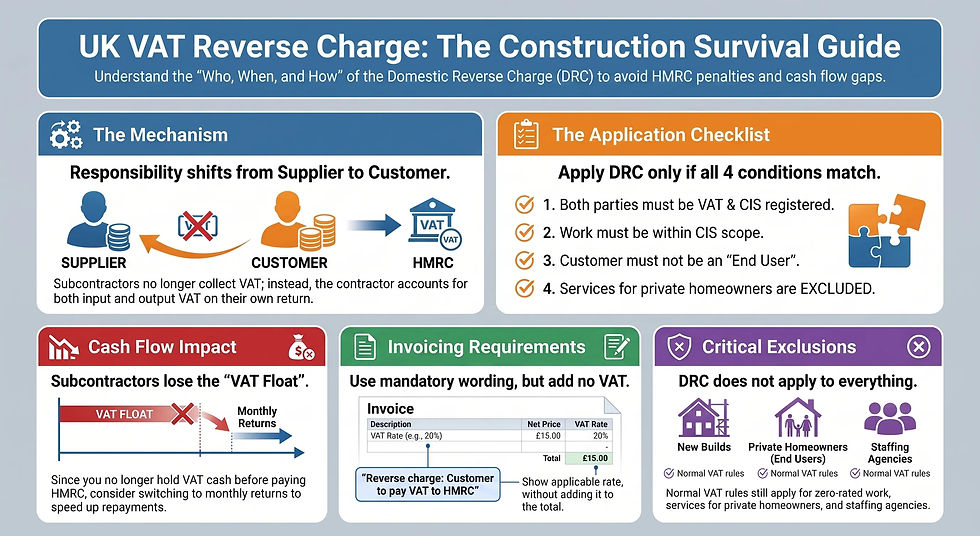
The domestic reverse charge for construction services applies to supplies of construction services between VAT-registered businesses in the construction industry where those services are within the scope of the Construction Industry Scheme. Under the reverse charge, the customer (the recipient of the supply) accounts for the VAT rather than the supplier.
This is fundamentally different from how VAT normally works. In a standard VAT transaction, the supplier adds VAT to their invoice and the customer pays it. The supplier then accounts for that output tax on their VAT return. Under the reverse charge, the supplier issues an invoice showing the net amount and the VAT rate but does not add the VAT to the amount payable. Instead, the customer self-accounts for the VAT as both output tax (as if they had made the supply) and input tax (as their purchase), effectively netting to nil in most cases.
The immediate consequence for a newly registered subcontractor is that they do not receive VAT from their contractor clients on reverse charge supplies. This matters enormously for cash flow modelling and is one of the most frequent misunderstandings I see among tradespeople who have just crossed the registration threshold.
Which Supplies Fall Within the Reverse Charge?
The reverse charge applies to supplies of construction services where both the supplier and the customer are VAT-registered, the customer is not the end user of the building, and the supplies are within the CIS. End users (property owners who are not contractors or developers) are excluded from the reverse charge, as are supplies to connected persons, suppliers of labour only, and certain other specified categories.
The term "end user" is important. A homeowner having an extension built is an end user and does not trigger the reverse charge. A national housebuilder or a Milton Keynes-based main contractor who engages subcontractors to complete residential or commercial developments is not the end user, and the reverse charge applies to those supplies.
In practical terms, most subcontractors working up the supply chain for main contractors, developers, or other VAT-registered construction businesses will be operating under the reverse charge for the bulk of their work.
How Does Registration Change the Cash Flow Picture?
Before registration, a subcontractor typically receives payment for their services without any VAT element. Once registered, the expectation that registration means receiving VAT on every invoice needs immediate qualification for those working within CIS.
For reverse charge supplies, the subcontractor issues an invoice for, say, £10,000 of electrical installation work. The invoice must state that the reverse charge applies and that the customer must account for the VAT. The subcontractor receives £10,000, not £12,000. They account for no output tax on that supply.
However, the subcontractor does account for input VAT on their own purchases. A newly registered electrical subcontractor buying £4,000 of materials and equipment in the quarter can recover the input tax on those purchases through their VAT return. In many cases, this results in a repayment VAT position from HMRC.
Businesses that supply mainly reverse charge construction services and are frequently in a repayment position may apply to move to monthly VAT returns to speed up the return of input tax. HMRC normally agrees to monthly returns where the business can demonstrate a regular repayment position.
Monthly returns are worth requesting early. The administrative overhead is modest and the cash flow benefit of receiving refunds monthly rather than quarterly can be meaningful, especially for tradespeople whose material costs are high relative to their labour charges.
Invoicing Under the Reverse Charge: What Must the Invoice Say?
The invoice must be correctly worded. An incorrectly worded VAT invoice on a reverse charge supply can cause problems for both the supplier and the recipient, particularly in an HMRC compliance check.
A reverse charge invoice for construction services should:
State the net amount of the supply without adding VAT.
Identify the applicable VAT rate (typically 20%).
Include a statement making clear that the domestic reverse charge applies and that the customer must account for the VAT. The exact wording is not prescribed but must make the position unambiguous. A phrase such as "Domestic reverse charge applies: customer to account for VAT at 20%" is clear and sufficient.
Include the supplier's VAT registration number.
Identify the customer's VAT registration number. The supplier should verify the customer's VAT registration before applying the reverse charge. HMRC provides a free online VAT number verification service.
One pattern I see repeatedly in construction practices is the failure to check whether the customer is actually VAT-registered before applying the reverse charge. If the customer is not registered, the reverse charge does not apply and the supplier should charge VAT in the normal way. Applying the reverse charge to a non-registered customer means the VAT has not been collected and has not been accounted for by anyone, which is a compliance failure on the supplier's part.

When Does Standard VAT Apply Rather Than the Reverse Charge?
There are several categories of supply where the reverse charge does not apply, even within the construction sector.
Supplies to end users attract normal VAT treatment. If a plumber in Buckinghamshire is engaged directly by a school, a hospital, or a homeowner, the supply is subject to standard VAT, not the reverse charge. The key question is whether the recipient of the services is the end user of the building.
Supplies of only materials, goods, or equipment, with no installation or construction service, are not covered by the reverse charge. A scaffolding hire company that simply delivers and collects equipment without erecting it is making a supply of goods, not construction services.
Supplies where the customer is an end user who has informed the supplier in writing of that status sit outside the reverse charge. End users can notify suppliers that the reverse charge does not apply, and the supplier should retain that notification.
Supplies to connected companies or individuals, as defined, may be exempt from the reverse charge. The conditions here are specific and should not be assumed without checking.
Zero-rated supplies (such as construction of new dwellings for qualifying purchasers) are within CIS but outside the reverse charge because they are zero-rated, not standard-rated.
How a Newly Registered Subcontractor Completes Their First VAT Return
The first VAT return is where many newly registered construction subcontractors get confused. The structure of the return looks different from what they expected, because reverse charge supplies appear in two boxes rather than one.
On the VAT return, a supplier of reverse charge services enters the net value of those supplies in Box 6 (total value of sales). No output tax is entered for those supplies. A customer who receives reverse charge supplies enters the VAT amount in both Box 1 (output tax) and Box 4 (input tax), and the net value in Box 7 (total value of purchases). The two entries in Box 1 and Box 4 for the same supply effectively cancel each other unless partial exemption or non-business use applies.
For a subcontractor working exclusively on reverse charge supplies, the VAT return may look unusual at first glance. Box 6 will be populated with the net value of all supplies made. Box 1 may show nil or a very small output tax figure (relating to any non-reverse charge supplies, such as work for an end user). Box 4 will show the input tax claimed on materials, equipment, and other purchases. The result is likely a net repayment from HMRC.
For a subcontractor who also does some direct consumer work alongside their CIS subcontract work, the return will have a mix. Direct work for homeowners is standard-rated VAT. The output tax on those supplies goes in Box 1. The reverse charge supplies go in Box 6 only. The returns are straightforward once the supplier understands which category each supply falls into.
The Mixed-Use Problem for Larger Subcontractors
Some trades work across both commercial construction (reverse charge) and direct-to-consumer domestic work (standard VAT). A Milton Keynes roofing firm that does commercial re-roofing for a main contractor Monday to Thursday and residential jobs for homeowners on Fridays is operating in both regimes.
This is not complicated in itself, but it does require clear record-keeping to separate which invoices fall under which regime. The most common error is applying the reverse charge to a supply that should have had standard VAT charged, or vice versa. Both are VAT errors with potential penalties attached.
A good practice is to use separate invoice sequences or clearly distinguish on the invoice whether the supply is reverse charge or standard, ideally noted at the point the job is booked, not as an afterthought when the invoice is raised.
The other issue that arises for mixed-use businesses is whether to opt for monthly returns. If the reverse charge work represents the majority of turnover, the business is likely in a regular repayment position. If the direct consumer work represents the majority, the business is probably a net payer and quarterly returns are fine.
What Happens If You Apply the Reverse Charge Incorrectly?
Applying the reverse charge when standard VAT should have been charged means the supplier has not collected VAT that was due. HMRC's position is that the liability falls on the supplier. If the customer has also not accounted for the VAT (because they received a reverse charge invoice and self-accounted accordingly, but they were actually an end user), the situation can become messy to unwind.
The opposite error, charging standard VAT on a reverse charge supply, means the customer has paid VAT they did not need to pay (and which the supplier must account for on their return). The customer can reclaim it as input tax, but it creates unnecessary cash flow costs and administrative friction.
HMRC has published guidance making clear that where a genuine mistake has been made, provided the parties correct it promptly and there has been no tax loss, enforcement is typically proportionate. However, systematic errors, particularly where the supplier consistently charges VAT on reverse charge supplies and then fails to account for it properly, can attract penalties and interest.
Practical Checklist for Newly Registered Construction Subcontractors
Before submitting the first VAT return, work through the following:
Confirm whether each customer is VAT-registered and verify their number through HMRC's online service before issuing any reverse charge invoice.
Establish whether each customer is an end user. If in doubt, ask them in writing. An end user should provide written confirmation that they are the end user of the building.
Retain that confirmation.
Check whether your supplies are within CIS and therefore potentially within the reverse charge. If you are a labour-only subcontractor, specific rules may affect your position.
Review whether monthly returns would benefit cash flow, particularly if material costs are high.
Ensure your invoicing software is capable of generating reverse charge invoices correctly, including the mandatory notation.
Reconcile the value of reverse charge supplies on the return against the invoices issued in the period. Box 6 should match, and if there are no non-reverse charge sales, Box 1 should be nil or close to nil.
Keep records of every communication confirming end-user status, as these support your decision to apply or disapply the reverse charge on any given supply.
Key Takeaways
The domestic reverse charge applies to standard-rated and reduced-rated construction services supplied between VAT-registered businesses within the scope of CIS, where the recipient is not the end user of the building. End users, domestic consumers, and non-CIS supplies are outside the reverse charge.
The compulsory VAT registration threshold for 2026/27 is £90,000 of taxable turnover in a rolling twelve-month period.
Subcontractors subject to the reverse charge do not add VAT to their invoices for those supplies. They do not receive VAT from their contractor clients. They do recover input VAT on their own purchases, frequently resulting in a repayment position.
Monthly VAT returns are available for businesses in regular repayment positions and are worth applying for promptly after registration.
Invoices for reverse charge supplies must include the required notation. Failing to invoice correctly, or misapplying the reverse charge, creates compliance risks for both the supplier and the recipient.
Mixed-use businesses (some CIS subcontract work, some direct consumer work) must correctly categorise each supply and apply the appropriate VAT treatment to each invoice.
FAQs
Q1: Does the value of reverse charge supplies count towards the VAT registration threshold for a small construction firm?
A1: Well, it's worth noting that this is one of the most practically useful quirks of the domestic reverse charge (DRC) rules, and it often catches people out , in a good way. The value of supplies that fall under the domestic reverse charge does not count towards your VAT registration threshold for the purposes of compulsory registration. So if you are a sole-trader roofer or a small groundworks firm turning over, say, £85,000 per year, but the bulk of that work is supplied to other VAT-registered contractors under CIS, the reverse charge portion of that turnover is excluded from the £90,000 threshold calculation.
This was deliberately built into the legislation to avoid forcing very small subcontractors into VAT registration solely because of the mechanics of the reverse charge. That said, do not assume this gives you a free pass forever. Any non-reverse charge income , such as work done directly for the public, private homeowners, or businesses that are not VAT-registered , will still count towards your threshold in the usual rolling 12-month way. Always monitor the full picture monthly, and if in doubt, confirm your position with HMRC or a qualified adviser.
Q2: What exactly must appear on a reverse charge invoice to satisfy HMRC requirements?
A2: In my experience with clients, the invoicing piece is where even experienced tradespeople come unstuck, and the consequences can be awkward. When the domestic reverse charge applies, your invoice must not show VAT charged in the usual way. Instead, it must clearly state that the customer is required to account for the VAT directly to HMRC. You should include the total net value of the work, the VAT rate that would apply, and the VAT amount that the customer must account for , even though you are not collecting it. A statement along the lines of "Reverse charge: customer to account for VAT of £X to HMRC at 20%" must appear on the face of the invoice. Crucially, you must also include your own VAT registration number and your customer's VAT registration number.
Leaving off the VAT amount is a common error , some subcontractors just write "reverse charge applies" and leave it at that, but HMRC's updated guidance makes clear that the amount must be stated so the contractor receiving the invoice knows exactly what to account for on their own return. Keep a copy of every reverse charge invoice issued, as HMRC may request these during a VAT inspection.
Q3: Can a construction subcontractor voluntarily register for VAT below the threshold, and does that actually make financial sense under the reverse charge regime?
A3: This is a question I get asked frequently, particularly from sole traders in the electrical and plumbing trades whose turnover sits comfortably below £90,000 but who do most of their work for VAT-registered contractors. The honest answer is: yes, voluntary registration is entirely permissible, and for many it genuinely pays off. Here is why. If the majority of your income comes from reverse charge supplies to contractors, registering voluntarily means you can reclaim the VAT you pay on your own business inputs , tools, van fuel, materials, insurance, even your accountancy fees , without having to charge VAT on your own invoices under the DRC.
Consider a self-employed plasterer in Bristol spending £15,000 a year on materials and equipment inclusive of VAT. That is roughly £2,500 of recoverable input tax sitting in his costs that he currently absorbs. After voluntary registration and operating under the reverse charge, he stops receiving output VAT from his contractor customers, but he starts reclaiming that input tax each quarter, improving his profitability noticeably. The caveat is that if any of your work goes directly to unregistered clients or the general public, you would then have to charge them VAT, which could affect your pricing competitiveness. Always run the numbers for your specific income mix before registering voluntarily.
Q4: What is an "end user" in the context of the domestic reverse charge, and how does someone notify their supplier of that status?
A4: The end user concept is one of the most misunderstood areas of the whole regime, and getting it wrong can create problems on both sides of the transaction. An end user is a person or business that receives construction services but does not pass those services on as part of their own construction output. Think of a supermarket chain having a new distribution centre built , they are the ultimate recipient of the construction work, not a business that will then sell on construction services. In that scenario, the reverse charge does not apply; normal VAT is charged by the contractor in the usual way. For the end user exemption to work, the end user must notify their supplier in writing before the supply takes place.
There is no prescribed wording in law, but HMRC suggests something along these lines: "We are an end user for the purposes of section 55A VAT Act 1994 reverse charge for building and construction services. Please issue us with a normal VAT invoice with VAT charged at the appropriate rate." This notification can be in an email, a letter, or built into the terms of a written contract. Both parties should retain copies of this notification indefinitely, as HMRC may request it during an inspection to verify why the reverse charge was not applied. One practical tip: if you are a contractor and a customer verbally tells you they are an end user, do not accept that. Always get it in writing before you issue a standard VAT invoice.
Q5: What happens to a construction business that is on the VAT Flat Rate Scheme when it starts receiving reverse charge supplies?
A5: This is genuinely one of the most disruptive consequences of the domestic reverse charge for smaller subcontractors, and I have seen several businesses blindsided by it. Under the Flat Rate Scheme, you normally pay a fixed percentage of your gross VAT-inclusive turnover to HMRC and keep the difference. That simplicity is the whole appeal. However, reverse charge supplies are entirely excluded from the Flat Rate Scheme calculation. When you receive reverse charge supplies as a contractor, you must account for the output VAT and input VAT on those supplies outside of your flat rate percentage, through the normal VAT boxes on your return. The problem is compounded for subcontractors.
Once most of your income becomes reverse charge income, you have very little standard-rated turnover left to apply the flat rate percentage to, which dramatically reduces the cash benefit of being on the scheme. Meanwhile, you are still paying the flat rate on your residual standard-rated income but cannot recover VAT on your reverse charge purchases through the flat rate mechanism in the normal way. Many subcontractors on the Flat Rate Scheme would genuinely be better off leaving it and moving to standard VAT accounting. Do not assume the scheme that worked well for you several years ago still serves you well now , model it properly with your accountant before each new tax year.
Q6: Can a construction business use the Cash Accounting Scheme for reverse charge supplies?
A6: In short, no, and this catches people out more than you might expect. The Cash Accounting Scheme allows a business to account for VAT only when it receives or makes payment, rather than when invoices are issued. It is a genuine cash flow lifeline for small businesses with slow-paying clients. However, the Cash Accounting Scheme cannot be used for supplies that fall within the domestic reverse charge. The reason is straightforward: under the reverse charge, no VAT actually changes hands between supplier and customer.
The contractor accounts for both the output and input VAT on their own return at the same time, so the cash-in/cash-out logic of the Cash Accounting Scheme simply does not apply. If your business is currently on the Cash Accounting Scheme and your work mix shifts substantially towards reverse charge supplies , perhaps because you win a large subcontract with a major housebuilder , you will need to review whether the scheme still benefits you on your remaining non-reverse charge work, or whether moving to standard quarterly accounting makes more sense overall. Always check the current position with HMRC guidance before switching between schemes.
Q7: If a subcontractor incorrectly charges VAT on a reverse charge supply, what are the consequences and how is it corrected?
A7: This is, if I am honest, one of the most common errors I see in practice, especially among smaller sole-trader builders who are new to the rules or are working with a contractor customer for the first time. If a subcontractor charges VAT when the domestic reverse charge should have applied, the contractor-customer should not simply pay the VAT element and then reclaim it as input tax , even though technically HMRC may allow the input tax recovery in certain cases. HMRC retains the power to assess the customer for output tax as if the correct reverse charge treatment had been applied, effectively meaning the customer could face a VAT liability even if they have already paid the VAT amount to the subcontractor.
The correct remedy is for the subcontractor to issue a correcting credit note and a revised invoice showing the reverse charge treatment, and for the customer to request a refund of the incorrectly charged VAT. Both parties should then apply the correct treatment going forward. The risk of not correcting this promptly is a VAT compliance failure on the customer's return, which HMRC can identify during a routine inspection. The practical lesson here is to agree the VAT treatment of a contract before any invoices are raised , not after the first one lands incorrectly.
Disclaimer
The information published on the above article is provided for general informational and educational purposes only. Although reasonable care is taken to ensure that the content is accurate, current and based on reliable sources at the time of publication, UK tax law, HMRC guidance, rates, thresholds and compliance requirements may change, and their application can vary depending on individual or business circumstances. Nothing on this blog constitutes personalised tax, accounting, financial, legal, immigration, investment or professional advice, and it should not be relied upon as a substitute for advice from a qualified professional adviser. Readers should seek tailored advice before making decisions, submitting returns, claiming reliefs, entering transactions, or taking or refraining from any action based on blog content.
Atlas Tax Advisors, its directors, CEO, employees, consultants, contributors, authors, editors and content creators accept no liability for any loss, penalty, interest, damage, claim, cost or consequence arising directly or indirectly from reliance on, interpretation of, or use of any information contained in these blog posts, to the fullest extent permitted by UK law. External references, examples and scenarios are illustrative only and do not create a client relationship. A professional relationship with Atlas Tax Advisors is formed only through formal engagement and agreed terms of service.

Comments