


CIS For Joiners and Carpenters: Workshop Manufacture Vs On-Site Fitting

Updated: Jul 28
CIS for Joiners and Carpenters: Workshop Manufacture vs On-Site Fitting
Whether CIS deductions apply to a joiner or carpenter depends on what work is actually being done, not simply on the trade label. Work carried out on a construction site typically falls within CIS. Work carried out in a workshop, producing components that are later delivered and fitted, occupies more complicated ground, and getting the classification wrong costs real money.
The core principle is straightforward: the Construction Industry Scheme covers construction operations. Manufacturing joinery items in a workshop is not, in itself, a construction operation. Installing those items at a building site generally is. The difficulty arises because most joinery and carpentry businesses do both, often on the same invoice.
What CIS Actually Covers for Joinery and Carpentry Work
CIS applies to payments made by contractors to subcontractors for construction operations carried out in the UK. Construction operations include the construction, alteration, repair, extension, and demolition of buildings and structures, along with the installation of systems within them.
Fitting and fixing work done at a construction site falls squarely within this definition. A carpenter installing door frames, fitting kitchen units into a new build, fixing skirting boards, or hanging doors on a domestic or commercial project is carrying out a construction operation. The contractor paying for that work must apply CIS deductions unless the subcontractor holds gross payment status.
Workshop manufacturing is different. A joinery firm that machines timber in its workshop, assembles bespoke staircases, frames, or fitted furniture off-site, and then delivers those items to a site has not, at the point of manufacture, performed a construction operation. The manufacturing stage is a production process, not a construction activity. This matters because CIS applies to payments for work, not to payments for goods.
HMRC's Construction Industry Scheme manual draws this line clearly. Work that constitutes the manufacture of components or materials is excluded from the scheme. The issue is that many joinery and carpentry invoices combine both elements without separating them.
The Practical Problem: Mixed Invoices
A joinery subcontractor based in Milton Keynes who supplies and fits bespoke window boards and architrave to a new development will typically issue a single invoice for the whole job. That invoice covers the cost of manufacturing the items in the workshop, the materials used, delivery to site, and the fitting labour. Only part of that invoice falls within CIS.
Where a payment covers both materials and labour, the CIS deduction applies only to the labour element. Materials supplied by the subcontractor are excluded from the deduction calculation.
Workshop manufacturing sits closer to the materials side of this line than the labour side, provided the items genuinely are prefabricated off-site and are not simply assembled on-site in a way that makes the "workshop manufacture" claim artificial. A piece of timber cut to size in a workshop and nailed in place on site is not a manufactured product in any meaningful sense. A bespoke staircase assembled in a workshop, finished, and delivered as a complete unit before being installed is a different matter.
The contractor paying the invoice needs to determine what portion relates to construction labour, what relates to materials, and what relates to manufactured components. The deduction applies to the labour element of on-site fitting. It does not apply to the manufactured product itself or to the materials content.
How Contractors Should Handle the Split
Where a joinery subcontractor provides a single undivided invoice, the contractor should ask for a breakdown before applying CIS deductions. This is not optional. Applying the full deduction rate to an invoice that includes manufactured goods would result in over-deduction. Making no deduction at all on an invoice that includes substantial fitting labour would result in under-deduction.
If a subcontractor cannot or will not provide a materials breakdown, the contractor must make a reasonable estimate of the materials element and deduct CIS only from the remainder.
In practice, a contractor who consistently applies full CIS deductions to joinery invoices that are predominantly for manufactured goods will be withholding tax the subcontractor never owed. That cash flow cost accumulates quickly across a project. A subcontractor with a large workshop element in their invoices should be clear about the breakdown, because silence tends to result in maximum deductions by default.
When Does Workshop Manufacture Become a Construction Operation?
The boundary is not always obvious. HMRC's position is that the relevant question is whether the work constitutes the making of materials or components, or whether it constitutes the carrying out of construction operations.
A useful test is to ask whether the work could have been done on-site. A staircase that is designed, machined, assembled, finished, and delivered as a complete unit could not reasonably have been constructed in situ, and the workshop manufacturing process is genuinely separate from the installation. The installation is a construction operation; the manufacture is not.
By contrast, a joiner who builds a stud partition wall on-site using timber framed in a workshop, with the "workshop" element being no more than basic cutting and drilling, is carrying out a continuous construction process. The workshop element is preparatory, not a distinct manufacturing stage.
HMRC's guidance draws attention to whether work was performed "on-site" in connection with a construction project. Off-site manufacturing that produces a finished or semi-finished product for incorporation into a structure is generally not a construction operation at the point of manufacture, but the subsequent installation is.
This mirrors the position for other trades. A steel fabricator manufacturing structural sections off-site, or a kitchen manufacturer producing units, operates outside CIS at the production stage. The relevant construction operation is the assembly and fitting at the building.

What Rate Applies When CIS Deductions Are Due?
CIS deductions are made at 20% for registered subcontractors without gross payment status, and at 30% for subcontractors who are not registered with CIS at all. Subcontractors with gross payment status are paid in full with no deduction.
For a joinery subcontractor with a mixed invoice, the contractor applies the relevant rate only to the labour element of on-site work. A subcontractor registered for CIS without gross payment status would have 20% deducted from their fitting and installation labour. Their workshop manufacturing element and materials cost pass through without deduction.
A Milton Keynes-based carpentry firm working across several development sites in Buckinghamshire, invoicing £30,000 per month for work that includes bespoke fitted furniture supply and installation, could be losing approximately £2,000 to £3,000 per month in unnecessary CIS deductions if contractors are applying the rate to the full invoice. On an annual basis that is a significant cash flow disadvantage, even allowing that the deductions are ultimately offset against tax.
Gross payment status removes this problem entirely for subcontractors who qualify. The eligibility test requires that the business's CIS subcontractor turnover exceeds £30,000 per year (for a sole trader) and that all tax filings and payments are up to date for the previous twelve months. Given how frequently joinery subcontractors with significant turnover fail to hold gross payment status simply because they have not applied, it is worth checking.
How the CIS Monthly Return Should Reflect the Workshop/Fitting Split
The contractor's CIS monthly return requires them to record, for each subcontractor payment, the gross payment made, the materials element excluded from the deduction, and the CIS deduction applied. Getting this right depends on having a reliable split from the subcontractor's invoice.
On the CIS monthly return, the contractor must record the total amount paid, the amount within that payment that represents materials cost, and the amount of tax deducted. The deduction is calculated on the payment minus the materials. GOV.UK
For a joinery invoice of £18,000 covering £7,000 of manufactured bespoke items and materials, £3,000 of delivery, and £8,000 of installation labour:
Materials and manufactured components: £10,000 (excluded from deduction) Installation labour: £8,000 (subject to 20% deduction) CIS deduction: £1,600 Net payment to subcontractor: £16,400
If the contractor had applied the 20% rate to the full £18,000, the deduction would have been £3,600, withholding £2,000 that should not have been deducted. The subcontractor recovers it eventually through Self Assessment or their corporation tax return, but it sits with HMRC in the interim.
Where the invoice genuinely does not split out the components, contractors should request a breakdown rather than guess. If no breakdown is forthcoming, a reasonable estimate based on knowledge of the job is required. An HMRC enquiry into a CIS-registered contractor will routinely review whether the materials figures on monthly returns are supported by invoices, and unsupported estimates attract attention.
Supply Only Without Fitting: Does CIS Apply?
A joinery business that manufactures and delivers products but performs no on-site installation sits outside the CIS regime for that transaction entirely. There is no construction operation being performed by the subcontractor, so there is no payment for a construction operation, and CIS does not apply.
A supply-only transaction, where a subcontractor delivers materials, components, or manufactured products to a site but does no installation work, is not a payment for a construction operation. No CIS deduction arises on a pure supply arrangement.
This has a practical relevance for joinery businesses that operate in two modes: supplying bespoke items to other carpentry firms who do the fitting, and directly fitting items themselves on other contracts. The supply-only contracts fall outside CIS; the supply-and-fit contracts fall partly within it. Some businesses prefer to separate these activities into distinct commercial arrangements precisely to keep the administration clean, though the CIS rules follow the substance of the transaction rather than how it is labelled.
A counter to this: if a joinery firm's "supply-only" arrangement involves its workers attending site to assist with placement, unloading in a way that forms part of the installation process, or providing supervisory involvement in the fitting carried out by others, HMRC may treat the transaction as more than a pure supply. The presence of the subcontractor's workers on site doing anything connected with installation is the point at which the supply-only argument begins to weaken.
Labour-Only Carpentry Subcontractors
The clearest CIS position is for labour-only subcontractors: carpenters and joiners who provide their skills on-site using the contractor's materials and tools, with no supply of their own goods or workshop manufacturing. Every pound of their invoice is for labour and therefore fully subject to CIS deduction at 20% (registered) or 30% (unregistered).
These subcontractors cannot claim any materials exclusion on their CIS deductions because they provide none. The full invoice is the labour figure, and the full CIS deduction applies.
For a labour-only joiner subcontractor earning £50,000 in a year from CIS contracts at a 20% deduction rate, HMRC holds £10,000 throughout the year on their behalf. If the joiner's actual income tax and NIC liability for the year is, say, £8,000, they are due a refund of £2,000, which they claim through Self Assessment. That refund process works correctly and is generally resolved within a few weeks of filing. The problem is that sole traders in this position sometimes do not file Self Assessment returns promptly, leaving the refund uncollected for a year or more.
Labour-only subcontractors with consistent annual earnings above the CIS gross payment status threshold (£30,000 for a sole trader) have the most to gain from applying for gross payment status. Receiving payment in full rather than net of 20%, and managing their own tax payments on the normal Self Assessment timeline, is a meaningful cash flow improvement.
A Practical Note on Invoicing
The most common practical error in this area is not a tax calculation error but an invoicing error. A joinery subcontractor who sends a single-line invoice for "supply and fix of bespoke joinery" without any breakdown invites the contractor to make the split themselves, and contractors under pressure tend to default to applying the full CIS rate rather than risk under-deduction.
Invoices should show:
A description of the manufactured items supplied (with their cost or value stated separately), the materials content where materials are distinct from the manufactured components, the labour element for on-site installation, and any separate delivery or collection charges.
This is not particularly onerous for a business with any reasonable bookkeeping system. Many joinery businesses already cost jobs this way internally. Putting the same breakdown on the client invoice means the CIS deduction is applied correctly without any negotiation, and the subcontractor receives the correct amount from the outset.
For a Buckinghamshire-based carpentry business working regularly with the same main contractors on residential developments, it is worth having a conversation about this once rather than correcting deductions repeatedly on each monthly payment. Contractors who understand the split will apply it consistently.
Key Takeaways
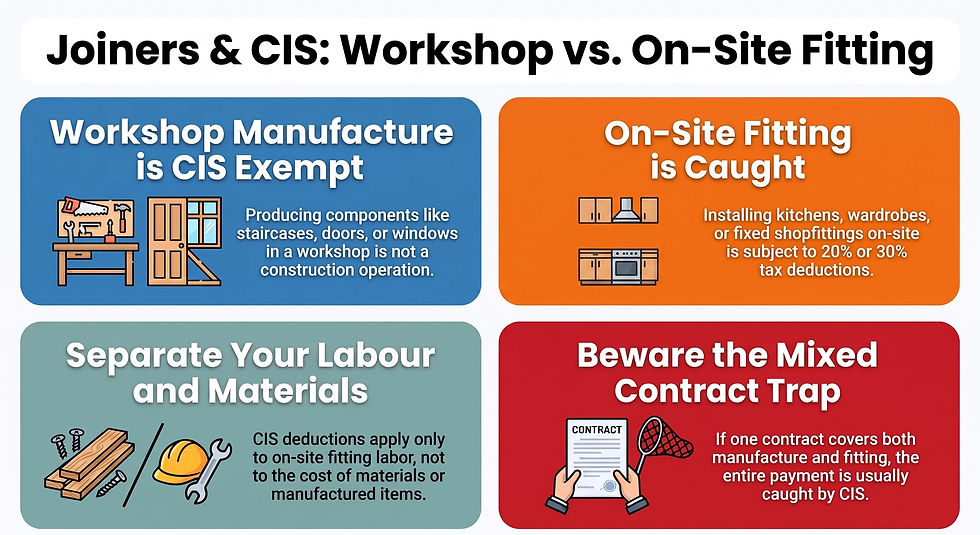
Workshop manufacture of joinery components is not a construction operation for CIS purposes. CIS deductions apply only to the on-site installation and fitting labour element of a joinery or carpentry invoice.
CIS deductions apply to the labour element of payments to subcontractors. Materials supplied by the subcontractor, including manufactured components, are excluded from the deduction calculation.
Where an invoice mixes manufactured goods and fitting labour, the contractor must apply the 20% or 30% deduction rate only to the labour portion. Applying it to the full invoice results in over-deduction.
Supply-only transactions, where no on-site fitting is performed, fall outside CIS entirely.
Labour-only subcontractors have no materials exclusion available. Their full invoice is subject to CIS deduction.
Subcontractors whose CIS deductions consistently exceed their actual tax liability should consider applying for gross payment status, provided their turnover and compliance record meet the criteria.
Subcontractors should itemise their invoices clearly. A single-line invoice for combined supply and installation almost always results in the contractor applying a blanket deduction rather than a correct one.
FAQs
Q1: Does a joiner who only manufactures bespoke furniture in their workshop and delivers it to site fall within the scope of CIS?
A1: The short answer is no, and this distinction matters enormously for how a joiner structures their business. HMRC's own manual at CISR14220 confirms that the manufacture of building or engineering components, materials, or equipment, together with delivery of those items to site, is expressly excluded from the Construction Industry Scheme. So a joinery business that makes bespoke staircases, window frames, or fitted cabinet carcasses in its workshop and drops them off at a development site has no CIS obligation whatsoever arising from that activity.
The exclusion is clear and deliberately drawn, because the scheme was always intended to target on-site labour, not factory production. Where it gets complicated, of course, is when the same joiner also turns up to do the fitting. The moment installation enters the picture, the entire character of the transaction changes. Consider a small workshop-based joinery outfit based near Bolton that manufactures and delivers door sets to a local developer: no CIS. The same business sends its own fitters to hang those doors on the same site: now CIS applies to the on-site work. Keeping those two activities properly separated, both contractually and invoiced, is where the planning discussion starts.
Q2: If a joiner or carpenter agrees a single contract to both make and fit joinery on site, does CIS apply to the whole contract or just the fitting element?
A2: This is one of the most commonly misunderstood aspects of the scheme for tradespeople in this sector. Once a contract contains any element of on-site installation of fixed joinery, HMRC treats the whole contract as falling within the scope of CIS. That is the effect of the mixed contract rule, which HMRC sets out at CISR14020. A joinery business that agrees to design, manufacture, and install a bespoke fitted library in a building undergoing renovation cannot say that only the fitting day's charge is subject to CIS deduction.
The contractor paying that joinery business must apply CIS to the entire contract payment, because the contract itself relates to construction operations by virtue of the installation element. The practical implication for a joiner receiving those payments is that materials they have purchased for the job can still be excluded from the deduction calculation, which softens the cash-flow impact somewhat. But the scope question, whether CIS applies at all, is answered by looking at the contract as a whole, not by counting hours on site versus hours in the workshop.
Q3: Can a joiner avoid CIS by raising two separate invoices, one for the workshop manufacture and one for the on-site fitting?
A3: Invoice splitting is one of the most frequently attempted workarounds in this area, and HMRC closes it firmly. It is the contract that determines whether CIS applies, not the invoice. HMRC's guidance at CISR14030 makes clear that artificially splitting a single contract across multiple invoices does not take any part of the work outside CIS. If the underlying arrangement is for a joiner to both make and install, and those elements are commercially interdependent, a contractor who separates the billing into a "manufacture invoice" and a "fitting invoice" cannot legitimately withhold CIS on just the fitting line and ignore the rest.
The scheme applies to the full payment under what is, in substance, one construction contract. That said, there is a legitimate planning point here. If a joiner genuinely operates a standalone manufacturing business under a separate trading entity or on separate contractual terms, with no obligation under that contract to carry out installation, that supply-only arrangement can sit outside CIS in its own right. The substance of what was agreed matters far more than the paperwork structure. HMRC can and does look through arrangements that are clearly designed to separate what is commercially one transaction.
Q4: Does the installation of a fitted kitchen count as a construction operation under CIS?
A4: Yes, and HMRC is quite explicit about this. CISR14150 and CISR14020 both confirm that installing fixed furniture in a building undergoing construction, alteration, extension, or repair is a construction operation within the scope of CIS. HMRC goes further, noting that the installation of such furniture can itself be regarded as an alteration to the building. So a joiner or carpenter hired by a main contractor to fit a kitchen in a new-build property is clearly within CIS. The contractor must verify the joiner with HMRC before the first payment, apply the correct deduction rate, and include the payment on the monthly CIS return.
A relevant question that often follows is whether work for a private homeowner changes this analysis, and it does, but not in the way many joiners expect. The private householder is not a contractor for CIS purposes, so a joiner fitting a kitchen directly for a family having their home refurbished does not receive a CIS deduction from that homeowner. The scheme operates between businesses in the supply chain, not between a private individual and a tradesperson they hire directly.
Q5: Does a joiner working directly for a private homeowner need to register for CIS or deal with CIS deductions?
A5: As a subcontractor receiving payment directly from a private householder, no. Private individuals carrying out work on their own domestic property are outside the contractor definition under CIS, so there is no mechanism for them to apply or withhold any deduction. A self-employed carpenter fitting bespoke wardrobes in someone's family home, dealing directly with that homeowner, receives no CIS deductions and does not need CIS registration purely on account of that work.
Where this gets more nuanced is if a joiner works for a kitchen company or a general building contractor who is then billing the homeowner. In that supply chain, the joiner is a subcontractor of a business, not of the private individual, and CIS applies normally between those businesses. The homeowner question only protects the joiner from deductions when there is genuinely no business intermediary in the chain above them.
Q6: How does a joiner calculate the correct CIS deduction base when an invoice includes both workshop-manufactured items and on-site labour?
A6: This is where the scheme requires careful invoicing, because the CIS deduction does not apply to the direct cost of materials incorporated into the work. The calculation works by taking the total gross amount, subtracting the verified cost of materials the joiner has genuinely purchased for the job, and applying the deduction rate to what remains. HMRC's guidance at CISR15060 confirms this, and importantly it includes the cost of manufacturing or prefabrication within the materials deduction.
So if a joiner quotes £5,000 for a project of which £2,800 represents the direct cost of timber, boards, fixings, and workshop machining time for the fabricated components, the CIS deduction at 20% applies to £2,200, not to £5,000. The contractor making the payment needs to see reasonable evidence of the materials figure. HMRC expects a clear breakdown on the invoice, and the contractor can ask for receipts or make a fair estimate if the joiner does not provide them. The practical advice is to ensure every invoice issued to a contractor shows a clear split between materials and labour, keeps the materials figure honest and evidenced, and is filed alongside the supporting purchase receipts.
Q7: Does the cost of a joiner's own workshop time, machinery use, and prefabrication count as "materials" for the CIS deduction calculation?
A7: Well, this is a point that many joiners miss, often to their financial detriment. HMRC includes the cost of manufacturing or prefabrication of materials within the definition of qualifying materials for the purpose of the CIS deduction. That means if a joiner fabricates bespoke components in their own workshop before bringing them to site, the raw material costs and the direct manufacturing costs associated with producing those components can properly be included as the materials element on the invoice. What cannot be claimed as materials is a general profit margin or a markup on top of the material cost.
The cost of the joiner's own plant, such as a van used to transport the materials, is excluded, as is the joiner's own accommodation or subsistence. The test is whether the cost is genuinely and directly attributable to materials that have been incorporated into the work. A joiner who manufactures timber panels, pays for the timber and the machining, and then installs them on site has a legitimate and often substantial materials deduction available, which meaningfully reduces the cash-flow impact of CIS deductions during the year.
Disclaimer
The information published on the above article is provided for general informational and educational purposes only. Although reasonable care is taken to ensure that the content is accurate, current and based on reliable sources at the time of publication, UK tax law, HMRC guidance, rates, thresholds and compliance requirements may change, and their application can vary depending on individual or business circumstances. Nothing on this blog constitutes personalised tax, accounting, financial, legal, immigration, investment or professional advice, and it should not be relied upon as a substitute for advice from a qualified professional adviser. Readers should seek tailored advice before making decisions, submitting returns, claiming reliefs, entering transactions, or taking or refraining from any action based on blog content.
Atlas Tax Advisors, its directors, CEO, employees, consultants, contributors, authors, editors and content creators accept no liability for any loss, penalty, interest, damage, claim, cost or consequence arising directly or indirectly from reliance on, interpretation of, or use of any information contained in these blog posts, to the fullest extent permitted by UK law. External references, examples and scenarios are illustrative only and do not create a client relationship. A professional relationship with Atlas Tax Advisors is formed only through formal engagement and agreed terms of service.
Comments