


CIS Registration for New Subcontractors in Milton Keynes: The First Month Done Right

CIS Registration for New Subcontractors: The First Month Done Right
If you are starting out as a self-employed subcontractor for 2026/27, you need a Unique Taxpayer Reference (UTR) before you can register for the, and you need CIS registration before any contractor can pay you at the standard 20% deduction rate rather than the higher 30% rate. Getting both sorted in your first few weeks, in the right order, is what determines whether your first month's pay reflects what you actually agreed with the contractor or arrives noticeably short.
I have lost count of how many first-month subcontractors ring up baffled because a contractor has deducted 30% rather than the 20% they were expecting, and almost every time the cause is the same: they started site work before their CIS registration had actually gone through, or the contractor verified them before the registration had caught up with HMRC's system. It is an entirely avoidable problem, and the fix is mostly about sequencing rather than anything complicated.
The Order Matters: UTR First, Then CIS
Your CIS registration cannot exist without a UTR. If you have never filed a Self Assessment return before, you almost certainly do not have one, and the two registrations should be done together rather than as separate steps.
When you register for Self Assessment as a new sole trader through , there is a specific option for "working as a subcontractor in the construction industry." Selecting that option registers you for Self Assessment and CIS in the same application, which is faster than registering for one and then going back to add the other. If you register as a general sole trader and forget to flag the CIS element, you will need a second step later to add CIS to an existing UTR, which is not difficult but does cost you time you often do not have if you are already lined up to start on site.
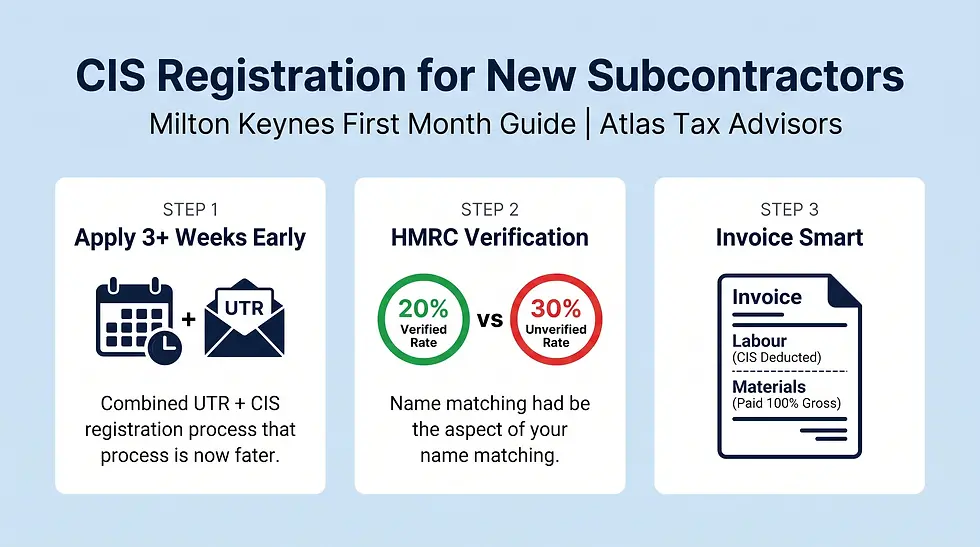
Once submitted, HMRC typically posts your UTR within around ten working days, though it can run longer, particularly during busy periods. This is the single biggest source of delay in the whole process and the one most new subcontractors underestimate. If you have already agreed a start date with a contractor, work backwards from that date and register at least three weeks ahead of it, ideally longer. A Milton Keynes example that comes up regularly: a groundworker who has just been offered a start on a new housing development off the H-road network, keen to start the following Monday, rings on the Thursday before to ask about CIS registration. At that point there is no realistic way to have a UTR in hand by Monday, and the honest answer is that the first few payments will be deducted at 30% regardless of what anyone does, simply because HMRC's post has not caught up yet.
Designed specifically for new construction subcontractors across Milton Keynes, this interactive visual guide from Atlas Tax Advisors explains how to navigate your critical first month under the Construction Industry Scheme (CIS) without losing cash flow to higher tax deductions. It demonstrates why the sequencing of your Unique Taxpayer Reference (UTR) and CIS registration matters, how contractor verification works, and why invoicing materials separately protects your take-home pay. Simply use the built-in sliders on the cash flow calculator to compare standard 20% versus unverified 30% deductions on your labour, explore the three-week planning roadmap, and work through the interactive readiness checklist before you step onto site.
What You Need Before You Start the Application
● National Insurance number
● Your legal name and, if different, your trading name
● Business address and start date of self-employment
● A mobile number, for two-factor authentication on your Government Gateway account
● Basic details of the construction work you will be doing
None of this is unusual or hard to gather. The mistake is not in the difficulty of the form, it is in leaving it until the week before you need to be paid.

Registering for CIS Once You Have a UTR
If you already have a UTR from a previous Self Assessment registration, perhaps you were employed and did some side work, or you have traded before under a different structure, you can register for CIS on its own using your existing Government Gateway credentials. You do not need to register for Self Assessment again. You simply add CIS to your existing account and confirm your subcontractor details.
Whichever route applies to you, the outcome you are aiming for is the same: your UTR needs to show as CIS-registered on HMRC's system before a contractor tries to verify you. Verification is the step where a contractor checks your details against HMRC's records before making a payment, and it is that check, not your own belief that you have registered, that actually determines the deduction rate applied to you.
Why Contractors Deduct 30% and How to Avoid It
A contractor is required to verify every new subcontractor with HMRC before the first payment. If your UTR is not found, or your name does not match exactly what HMRC holds against it, the contractor has no choice but to apply the higher 30% rate. This is not a penalty imposed on you personally by the contractor, it is what the system defaults to when verification cannot confirm your registration.
The detail that catches people out most often is the exact match on your legal name. If you registered as "J Smith Construction" but your contractor enters "James Smith" or vice versa, verification can fail even though you are correctly registered. Always give contractors the precise legal name and trading name combination you used when you registered, not a shortened or informal version, and give your UTR alongside your National Insurance number so there is no ambiguity in the record the contractor is checking against.
If a first payment does come through at 30% because registration had not caught up yet, this is not lost money. It is an advance payment against your eventual Income Tax and National Insurance liability and will be credited when you file your Self Assessment return. It is simply cash you do not have in the meantime, which is exactly the problem worth avoiding through better timing rather than something to write off.
Setting Up Your First Month Properly
Registration is only the first piece. A handful of habits from day one make the rest of your first year considerably less stressful.
Open a separate business bank account, or at minimum a separate pot
You do not strictly need a dedicated business account as a sole trader, but keeping construction income and personal spending mixed in one account makes it far harder to track what has actually been deducted, what materials you have paid for, and what your real profit looks like by the time your first Self Assessment return is due. Most subcontractors who struggle to reconstruct their first year's figures are struggling because everything ran through one account with no separation.
Keep every payment and deduction statement
Contractors are required to give you a monthly statement showing what they paid you and what they deducted. These statements are your evidence for the CIS deductions you will claim credit for on your Self Assessment return, and losing them means reconstructing the figures later from bank statements, which is slower and more error-prone. Keep them in one folder, digital or physical, from your very first payment.
Track the Self Assessment registration deadline separately from CIS
Registering for CIS does not automatically mean you have satisfied every Self Assessment obligation going forward, though in practice the combined online route covers both at once for most new sole traders. The point worth flagging clearly: if you started self-employment partway through 2026/27, the deadline to be registered for Self Assessment for that tax year is 5 October 2027, the 5 October following the end of the tax year in which you began trading. Missing that date, even if you have been quietly registered for CIS and having deductions taken the whole time, can still trigger a failure-to-notify penalty if HMRC was not properly told about your Self Assessment position by the deadline. Registering for both together at the start, as described above, avoids this being an issue at all, which is the main reason I push new subcontractors towards doing it that way rather than piecemeal.
Decide early whether materials will be itemised separately on your invoices
CIS deductions apply only to the labour element of a payment, not to the direct cost of materials you have genuinely supplied and used on the job. If your invoices bundle labour and materials into a single figure, a contractor may deduct CIS from the whole amount rather than just the labour portion, which overstates your deduction and understates your cash in hand for that job. Get into the habit from your very first invoice of showing labour and materials as separate lines, with materials shown at cost.
Understand what gross payment status would mean, even if you do not qualify yet
You will not qualify for gross payment status in your first month, since it requires a minimum net construction turnover, currently £30,000 for a sole trader, along with a clean compliance record over a qualifying period, which by definition you cannot yet demonstrate as a brand new business. But it is worth knowing it exists and what it changes: instead of a contractor deducting tax at source, you would be paid in full and settle everything through Self Assessment. Full detail on this and on the standard payment process for subcontractors is on . For your first year, the more relevant goal is simply making sure you are on the 20% rate rather than 30%, since gross payment status is realistically a second-year or later conversation for most new subcontractors.
This interactive explainer walks you through everything a new self-employed subcontractor in Milton Keynes (and across the UK) needs to know to get CIS registration right in the first month of 2026/27, so you avoid the common trap of 30% deductions instead of the standard 20%. It covers the correct order of steps (UTR first, then CIS), what documents and details you need, why verification fails, practical first-month habits, a worked cash-flow example, and the key deadlines. Simply tap the tabs at the top to move between sections, open the expandable tips for more detail, and use the built-in calculator to see the difference between deduction rates on your labour invoices. Everything is based on current HMRC guidance and has been prepared by Atlas Tax Advisors to help you start on the right footing.
A Worked Example of a Poorly Timed Start
Take a young electrician taking on his first subcontract role, fitting out new-build homes on a site near Wolverton for a main contractor. He agrees a start date, gets excited, and turns up on site the following week having only registered for Self Assessment and CIS three days earlier. His UTR has not yet arrived, so the contractor cannot verify him and deducts 30% from his first two payments, roughly £2,400 total on £8,000 of labour invoiced across those first weeks, rather than the £1,600 he would have paid at 20%. Once his UTR arrives and verification goes through cleanly, later payments move to 20%, but the £800 difference on those first two payments is not lost, it simply sits with HMRC until his Self Assessment return the following January, at which point it is credited against his tax bill along with everything else deducted through the year.
Nothing about that outcome is a disaster. He gets the money back eventually. But he spent the first six weeks of self-employment short of cash he was expecting, at exactly the point when he was also buying tools and covering his own travel costs before any refund was anywhere close to being paid. A fortnight's earlier registration would have avoided the entire problem.

Key Takeaways
● You need a UTR before you can register for CIS. If you have never filed Self Assessment before, register for both together by selecting the subcontractor option, rather than doing them as two separate steps.
● Allow at least three weeks, and ideally longer, between registering and your intended start date, since HMRC typically takes around ten working days to post a UTR and this is the step most new subcontractors underestimate.
● Contractors must verify you with HMRC before your first payment. A mismatch in your registered name is the most common reason verification fails and 30% gets deducted instead of 20%.
● The Self Assessment registration deadline for anyone who started self-employment during 2026/27 is 5 October 2027, though registering for CIS and Self Assessment together at the outset usually removes this as a separate concern.
● Keep payment and deduction statements from day one and itemise materials separately on invoices, since CIS only applies to labour.
FAQs
How long does it take to register for CIS as a new subcontractor?
If you already have a UTR, CIS registration itself can often be completed online in a matter of minutes. If you need a UTR first because you have never filed Self Assessment before, allow around ten working days for HMRC to post it, and register well before your intended start date to avoid being deducted at the higher rate.
Why is my contractor deducting 30% instead of 20% from my payments?
This happens when a contractor cannot verify your CIS registration with HMRC, usually because your UTR has not yet been issued, your registration has not fully processed, or the name given to the contractor does not exactly match HMRC's records for your UTR.
Do I need a UTR before I can start work as a subcontractor?
You can technically start work without one, but you will be deducted at the higher 30% rate until you are registered and verified, so it is far better to register in advance rather than starting work and dealing with registration afterwards.
Can I register for CIS and Self Assessment at the same time?
Yes, and for most new sole trader subcontractors this is the better route. When registering for Self Assessment online, selecting the option for working as a subcontractor in the construction industry registers you for both at once.
What happens to the extra tax deducted at 30% if my registration was delayed?
It is not lost. CIS deductions, whether at 20% or 30%, are advance payments towards your Income Tax and National Insurance for the year, and any amount deducted is credited against your final tax bill when you file your Self Assessment return.
Do CIS deductions apply to materials as well as labour?
No, CIS deductions apply only to the labour element of a payment. The direct cost of materials you have genuinely supplied should be shown separately on your invoice so the contractor does not deduct CIS from that portion.
When do I need to register for Self Assessment if I started self-employment during the 2026/27 tax year?
The deadline is 5 October 2027, the 5 October following the end of the tax year in which you began trading. Missing it can trigger a failure-to-notify penalty even if you have separately been CIS-registered and had deductions taken throughout.
Can I apply for gross payment status as soon as I register for CIS?
Generally not straight away. Gross payment status requires a minimum net construction turnover, currently £30,000 for a sole trader, plus a clean compliance record, neither of which a brand new subcontractor will yet have. It is worth understanding for later, but not something to plan around in your first month.
What documents should I keep from my first month as a subcontractor?
Keep every payment and deduction statement issued by contractors, copies of your invoices showing labour and materials separately, and evidence of your business expenses. These form the backbone of your first Self Assessment return.
Disclaimer
The article content is checked against primary sources, including GOV.UK and HMRC guidance and manuals, and is reviewed at least annually. Worked examples and figures are illustrative and are included to show how the rules apply in principle. They are not a calculation of your own liability.
Tax is highly fact-sensitive. Small differences in circumstances, timing, residence, or structure can change the outcome significantly, and the rules themselves change frequently. This article is therefore general information and is not advice for your situation. You should not act, or refrain from acting, on the basis of this article alone. Atlas Tax Advisors accepts no liability for any loss arising from reliance on it without taking advice. For your specific situation, please contact us or any professional accountant.
Comments