


When Should A New Subcontractor Engage An Accountant?

When Should a New Subcontractor Engage an Accountant in the UK?
New subcontractors in the UK, particularly those in construction under the Construction Industry Scheme (CIS), quickly encounter a web of compliance obligations, cash-flow pressures, and tax-planning decisions. While many start by handling matters themselves, the point at which professional help becomes valuable , or essential , varies by individual circumstances.
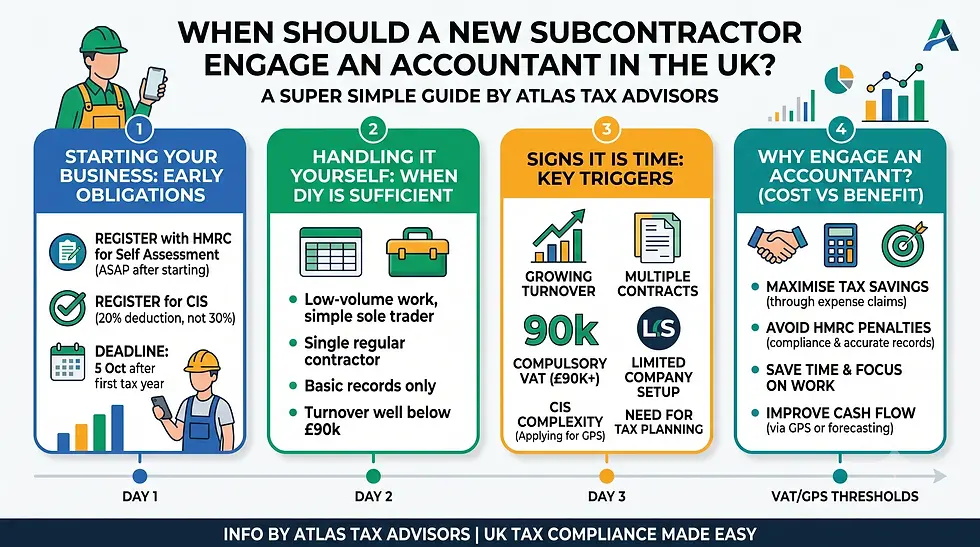
Early Obligations: What Every New Subcontractor Must Handle
If you begin working as a self-employed subcontractor, you must register with HMRC. For most, this means registering for Self Assessment. You should do this promptly upon starting, even if your first tax return is not due until the following 31 January. The key registration deadline is 5 October following the end of the tax year in which you started trading (for example, if you start in 2026/27, register by 5 October 2027 if required). Late notification can trigger penalties.
Under CIS, which covers most construction work (site preparation, alterations, repairs, etc.), contractors must deduct tax from payments to you at source , typically 20% on the labour element if you are registered, or 30% if not. Registering for CIS avoids the higher rate and ensures deductions count as payments on account towards your final tax bill. You can register online via Government Gateway when starting work in the industry.
Limited company subcontractors face additional layers. They must handle Corporation Tax, confirm employment status (including potential IR35 implications), and manage set-off of CIS deductions against PAYE and NIC liabilities. From April 2026, changes to small company thresholds for IR35 (turnover up to £15m, balance sheet £7.5m, employees under 50) may shift determination responsibility in some cases.
Basic record-keeping is mandatory from day one: income, expenses, materials (critical for CIS), and subcontractor payments if you later engage others. You do not need an accountant for simple registration, but errors here compound quickly.
When DIY Is Usually Sufficient
For very low-volume or occasional work, many new subcontractors manage without immediate professional support:
● Turnover well below the £90,000 VAT threshold (2026/27).
● Simple sole trader setup with one or two regular contractors.
● Straightforward expenses (tools, travel, materials) and no complex deductions.
● Comfort with HMRC online services for registration and basic Self Assessment.
I
n these cases, using free HMRC tools, spreadsheets, or basic accounting software often suffices for the first year. CIS deductions provide a built-in payment-on-account system, reducing the risk of a large unexpected bill , provided records are accurate.
Many start this way successfully. However, what begins as simple can scale faster than expected, especially in construction where projects arrive in bursts.
Signs It Is Time to Engage an Accountant
Most new subcontractors benefit from specialist input sooner than they expect. Here are the practical triggers:
1. CIS Complexity and Gross Payment Status (GPS) Ambition
Applying for GPS (0% deduction) requires meeting turnover, compliance, and business tests. The turnover test demands a minimum annual figure (historically around £30,000 or equivalent for shorter periods), with strict compliance history. Mistakes in the application or ongoing records can lead to rejection or revocation, hitting cash flow immediately. A CIS accountant ensures the application is robust and monitors ongoing eligibility.
2. Growing Turnover or Multiple Contracts
As income rises towards £50,000+, tax and Class 4 NICs become material (6% on profits between the personal allowance and higher rate threshold in 2026/27). Expense tracking, capital allowances, and accurate apportionment of mixed costs matter more. Multiple clients increase the volume of deduction statements and reconciliation work.
3. Approaching or Exceeding VAT Threshold
Once taxable turnover exceeds £90,000 (or you expect to), VAT registration is compulsory within 30 days of the end of the relevant month. Partial exemption, CIS interaction, and reclaiming input VAT on materials require careful handling. Late registration penalties apply.
4. Limited Company Considerations
If operating via a PSC, you need proper payroll for any salary, dividend planning, IR35 risk assessment (especially with 2026 threshold changes), and efficient use of CIS set-offs. Corporation Tax filings and confirmation statements add to the load.
5. Record-Keeping or Compliance Concerns
Poor records risk HMRC enquiries, incorrect Self Assessment, or disputes over allowable expenses. CIS Accountants establish proper systems early, reducing stress at year-end.
6. Tax Planning and Cash-Flow Optimisation
Beyond compliance, good advice covers pension contributions, equipment investment timing, loss relief, and structuring for family involvement where appropriate. For CIS subcontractors, accurate monthly/quarterly forecasting prevents nasty surprises.
7. Peace of Mind After a Mistake or HMRC Contact
Receiving a query, facing a penalty, or realising you under-claimed expenses are common points where subcontractors seek help. Early engagement often prevents these.
Realistic Scenarios
Consider a plumber starting as a sole trader in mid-2026 with one main contractor. In the first few months, with turnover under £20,000 and simple van/travel costs, they handle CIS registration and basic records themselves. By the following spring, with two more clients and turnover approaching £60,000, they engage an accountant to prepare the first full Self Assessment, optimise expenses, and check GPS eligibility. The accountant spots additional allowable costs and sets up better invoicing, improving net cash position.
A bricklaying limited company with several sites might need support from the outset for IR35/contract reviews, monthly EPS filings, and set-off claims. Delaying here risks compliance failures that outweigh fee costs.
Cost Versus Benefit
Accountant fees for new subcontractors typically range from a few hundred pounds for basic Self Assessment and CIS support to more for limited companies or complex planning. Many offer fixed-fee packages. The value usually comes from:
● Time saved (invoicing, records, filings).
● Tax savings through better expense claims and planning.
● Avoided penalties and interest.
● Improved cash flow via GPS or accurate forecasting.
● Professional representation if issues arise.
For many, the effective cost is modest relative to turnover once the business reaches even moderate scale.
Choosing the Right Support
Look for accountants with specific CIS and subcontractor experience rather than generalists. Check membership of recognised bodies (e.g., ICAEW, ACCA) and ask about their process for new clients, including onboarding, software integration, and ongoing support levels. Authorising them via form 64-8 (or online) allows direct HMRC interaction.
Start with a consultation to map your specific setup before committing.
Key Takeaways
● Registration is non-negotiable but basic compliance can often be DIY initially.
● Engage a CIS accountant when CIS/GPS, VAT, growth, or limited company rules add meaningful complexity , typically once turnover gains momentum or multiple contracts appear.
● Specialist input pays for itself through compliance, optimisation, and time savings for most subcontractors beyond the very smallest operations.
● The earlier you establish good systems, the smoother scaling becomes and the lower the long-term risk.
Deciding when to bring in professional help is ultimately a judgment on your personal capacity, risk tolerance, and business trajectory. For many new subcontractors in 2026, getting expert support once the work flows steadily proves one of the more practical investments in building a sustainable operation.
If your situation involves specific turnover figures, industry niche details, or limited company structures, a tailored consultation will provide clearer timing than general guidance.
FAQs
Q1: Can a brand new subcontractor with very low initial turnover still justify hiring an accountant right away?
Well, in my experience with clients just starting out in trades like plumbing or electrical work, it often comes down to your background rather than pure numbers. If you've got no prior Self Assessment experience and you're juggling CIS registration alongside your first jobs, even £10k-£15k of early turnover can make professional setup worthwhile. One Leeds-based electrician I advised saved enough on correctly claimed van expenses and tool allowances in his first year to cover the initial fee, simply because he avoided common record-keeping pitfalls that HMRC later queries.
Q2: What if I'm a subcontractor who also has a day job with PAYE, when does an accountant become essential?
It's a common mix-up for those easing into subcontracting. If your CIS work pushes total income over the personal allowance or creates overlapping tax codes, you risk under or overpaying without proper reconciliation. I've seen clients in Manchester where the PAYE code didn't account for CIS deductions properly, leading to a surprise bill. An accountant helps integrate both income streams early, especially if you're claiming work-related expenses against your employment too.
Q3: How does operating through a limited company as a new subcontractor change the accountant decision timeline?
Limited company subcontractors often need support sooner than sole traders. Corporation Tax filings, dividend planning, and claiming CIS deductions against company liabilities add layers most new directors underestimate. A client in Birmingham who set up his bricklaying company found that getting payroll and confirmation statements right from month one prevented compliance headaches that could have cost more than the accountant's monthly package.
Q4: Is it worth engaging an accountant just to apply for Gross Payment Status (GPS)?
Yes, particularly if your projected turnover qualifies. The application involves strict business, turnover, and compliance tests, and HMRC can be unforgiving on incomplete evidence. In practice, I've helped several new subcontractors strengthen their cases with proper forecasts and bank records, turning a potential 20% deduction into gross payments and significantly improving cash flow from the outset.
Q5: What should a subcontractor do if they've already made mistakes with CIS deductions before seeing an accountant?
Don't panic, many do. Common issues include losing deduction statements or not separating materials correctly. An accountant can help reconstruct records for your Self Assessment, claim over-deducted tax back, and set up better systems going forward. One subcontractor I worked with recovered several thousand pounds this way after his first busy summer.
Q6: How do Scottish or Welsh tax rates affect a new subcontractor's need for professional advice?
The divergence in income tax bands north of the border or in Wales can catch people out when combined with CIS. A higher-rate Scottish taxpayer might benefit from different pension or loss relief strategies. I always recommend specialist input if you're cross-border or living in one nation while working in another, as it affects effective tax planning beyond basic Self Assessment.
Q7: Can an accountant help a new subcontractor who also rents out a property on the side?
Absolutely, property income alongside CIS work creates overlapping reliefs and record-keeping demands. Many underestimate how rental losses or capital allowances interact with trading profits. A hypothetical client in Bristol with a small portfolio found that coordinated advice prevented double-claiming errors and optimised overall tax.
Q8: What red flags in my first few months of subcontracting suggest I need an accountant immediately?
Frequent queries from contractors about your status, difficulty tracking mixed material and labour invoices, or anxiety about the upcoming 31 January deadline are classic signs. If you're spending more than a couple of hours weekly on admin while trying to grow the business, it's usually false economy to continue solo.
Q9: Does hiring an accountant make sense if I plan to scale quickly and take on my own subcontractors later?
It does, and earlier is better. Setting up compliant systems for verifying and paying your own subs under CIS from day one avoids nasty surprises. Clients who've done this tell me the structured advice on employment status and monthly returns paid dividends when their operation grew.
Q10: How do pension contributions factor into the decision for a new subcontractor?
Pension planning is often overlooked early on. An accountant can model how relief at source or net pay arrangements work with fluctuating CIS income, potentially reducing your tax bill significantly. For higher earners approaching the annual allowance, this becomes crucial within the first 12-18 months.
Disclaimer
The information published on the above article is provided for general informational and educational purposes only. Although reasonable care is taken to ensure that the content is accurate, current and based on reliable sources at the time of publication, UK tax law, HMRC guidance, rates, thresholds and compliance requirements may change, and their application can vary depending on individual or business circumstances. Nothing on this blog constitutes personalised tax, accounting, financial, legal, immigration, investment or professional advice, and it should not be relied upon as a substitute for advice from a qualified professional adviser. Readers should seek tailored advice before making decisions, submitting returns, claiming reliefs, entering transactions, or taking or refraining from any action based on blog content.
Atlas Tax Advisors, its directors, CEO, employees, consultants, contributors, authors, editors and content creators accept no liability for any loss, penalty, interest, damage, claim, cost or consequence arising directly or indirectly from reliance on, interpretation of, or use of any information contained in these blog posts, to the fullest extent permitted by UK law. External references, examples and scenarios are illustrative only and do not create a client relationship. A professional relationship with Atlas Tax Advisors is formed only through formal engagement and agreed terms of service.
Comments